()
for (let i: i32 = 0; i < 3; i++) {
if (currentBalancesUsd[i].gt(desiredBalancesUsd[i])) {
surpluses.push(new Bucket(i, currentBalancesUsd[i].minus(desiredBalancesUsd[i])))
} else if (desiredBalancesUsd[i].gt(currentBalancesUsd[i])) {
deficits.push(new Bucket(i, desiredBalancesUsd[i].minus(currentBalancesUsd[i])))
}
}
// If either side is empty, portfolio already matches targets
if (surpluses.length == 0 || deficits.length == 0) {
log.info('No rebalance needed (target ratios matched)')
return
}
// Swap from tokens with extra (surplus) to tokens that need more (deficit).
// Always move the smaller USD amount between the two buckets.
// Repeat until either the surplus or the deficit bucket is satisfied.
let surplusIndex: i32 = 0
let deficitIndex: i32 = 0
while (surplusIndex < surpluses.length && deficitIndex < deficits.length) {
const movedUSD = usdMin(surpluses[surplusIndex].amountUSD, deficits[deficitIndex].amountUSD)
const surplusTokenIndex = surpluses[surplusIndex].index
const deficitTokenIndex = deficits[deficitIndex].index
// Convert USD amount to token in/out amounts using token metadata
// The input token amount is what we sell; the expected output token amount
// is the USD-equivalent we want to buy before slippage is applied.
const amountInToken = movedUSD.toTokenAmount(tokensMetadata[surplusTokenIndex])
const expectedOutToken = movedUSD.toTokenAmount(tokensMetadata[deficitTokenIndex])
// Apply slippage tolerance to compute minimum acceptable output
// `slippageBps` bounds the worst price movement we are willing to accept.
// minimumOut = expectedOut * (1 - slippageBps/10000)
const slippageFactor = BPS_DENOMINATOR.minus(BigInt.fromI32(inputs.slippageBps as i32))
const minimumOutAmount = expectedOutToken.amount.times(slippageFactor).div(BPS_DENOMINATOR)
// Execute swap from surplus token to deficit token with slippage protection
Swap.create(
inputs.chainId,
tokensMetadata[surplusTokenIndex],
amountInToken.amount,
tokensMetadata[deficitTokenIndex],
minimumOutAmount
).send()
// Update remaining USD amounts in both buckets
// We subtract the USD we just moved; if a bucket hits zero, advance.
surpluses[surplusIndex].amountUSD = surpluses[surplusIndex].amountUSD.minus(movedUSD)
deficits[deficitIndex].amountUSD = deficits[deficitIndex].amountUSD.minus(movedUSD)
// Advance to next bucket if this one is fully satisfied
if (surpluses[surplusIndex].amountUSD.le(USD.zero())) surplusIndex++
if (deficits[deficitIndex].amountUSD.le(USD.zero())) deficitIndex++
}
// At this point, all surpluses have been swapped into deficits within the
// provided slippage tolerance, approximating the target allocation.
log.info('Rebalance executed')
}
```
You can set up a wallet rebalancing strategy with any ERC-20 token across all supported chains, including ****Arbitrum, Base, Base Sepolia, Ethereum, Gnosis, Optimism, and Sonic****.
Every function is fully customizable, so you can adapt it to your preferred configuration. For details, explore the [Mimic Protocol Library](https://docs.mimic.fi/developers/library).
For now Mimic functions allows creating three types of intents: transfers, generic calls, and crosschain swaps.
### 5. Compile
The compile process converts your function logic and manifest into deployable artifacts:
- `build/function.wasm` - Compiled WebAssembly binary
- `build/manifest.json` - Processed manifest configuration
Run the compile command:
```
yarn mimic compile
```
By default, outputs are saved in the `build` directory.
Here is an example of the output produced by this command:
```
build/
├── function.wasm # Compiled WASM binary
├── manifest.json # Validated manifest
```
### 6. Deploy your function
This is where you upload your function artifacts to the network so others can discover it. To do this you can run the `deploy` command using the CLI:
```
yarn mimic deploy --api-key [DEPLOYMENT_KEY]
```
You can **generate a deployment key from the explorer app**, where you can login using your wallet.
> Link to Mimic Protocol Explorer: [https://protocol.mimic.fi/](https://protocol.mimic.fi/)
This command will deploy the generated artifacts from the `build` directory by default.
This command will upload your artifacts to the Mimic Registry (which stores them on IPFS) and pin the resultant CID so it can be discovered by others. The CID is also written to `CID.json` in the specified output directory.
### 7. Give allowance to the Mimic settler
Before you configure your function in the dashboard, you must allow the Mimic Settler contract to spend tokens on your behalf.
To grant this permission:
1. Open your network’s block explorer and find your spending token contract.
2. Connect your wallet.
3. Set the Mimic Settler as the spender address.
4. Approve the contract so it can manage the tokens needed for your function.
Mimic Settler contract:
```
0x609d831c0068844e11ef85a273c7f356212fd6d1
```
For example, for USDC on Base, you can go to the smart contract on basescan, click on "write as proxy", connect your wallet, and add approval to the Mimic settler.[https://basescan.org/address/0x833589fCD6eDb6E08f4c7C32D4f71b54bdA02913#writeProxyContract](https://basescan.org/address/0x833589fCD6eDb6E08f4c7C32D4f71b54bdA02913#writeProxyContract)
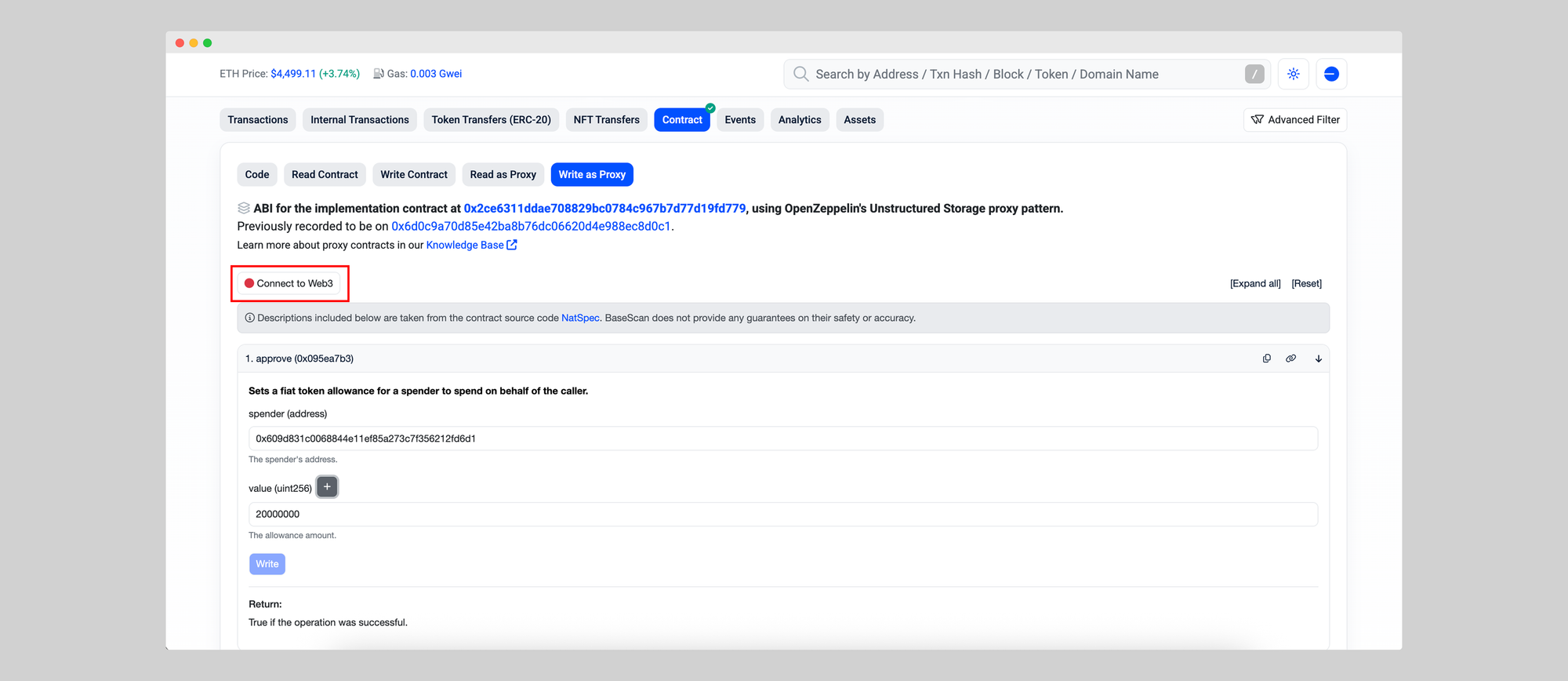
The spender is the Mimic settler, and the value depends on the token you want to use in uint256 (USDC has 6 decimals, so the amount + 6 extra zeros).
If you want to allow 20 USDC spending limit, you would write 20000000 (20 + 6 zeroes). Most explorers allow to add them easily as shown below.
Give allowance to the Mimic settler for the tokens you want to rebalance.
In this example USDC, WETH, and cbBTC on Base. You can go to the smart contracts on basescan, connect your wallet, and add approval to the Mimic settler: 0x609d831c0068844e11ef85a273c7f356212fd6d1
[USDC](https://basescan.org/address/0x833589fcd6edb6e08f4c7c32d4f71b54bda02913#writeProxyContract) | [WETH](https://basescan.org/address/0x4200000000000000000000000000000000000006#writeContract) | [cbBTC](https://basescan.org/address/0xcbB7C0000aB88B473b1f5aFd9ef808440eed33Bf#writeProxyContract)
### 8. Configure your function
After deploying your function, you can now add a trigger, to tell which trigger relayers should use to run your function. This means defining the parameters declared in your `manifest.yml` file. This is done in the [explorer UI](https://protocol.mimic.fi/) where you will be requested to sign your trigger with your wallet or with the SDK.
1. Open the explorer and locate the function you just deployed under the functions section.
2. Add or edit your trigger parameters
3. Sign the new trigger
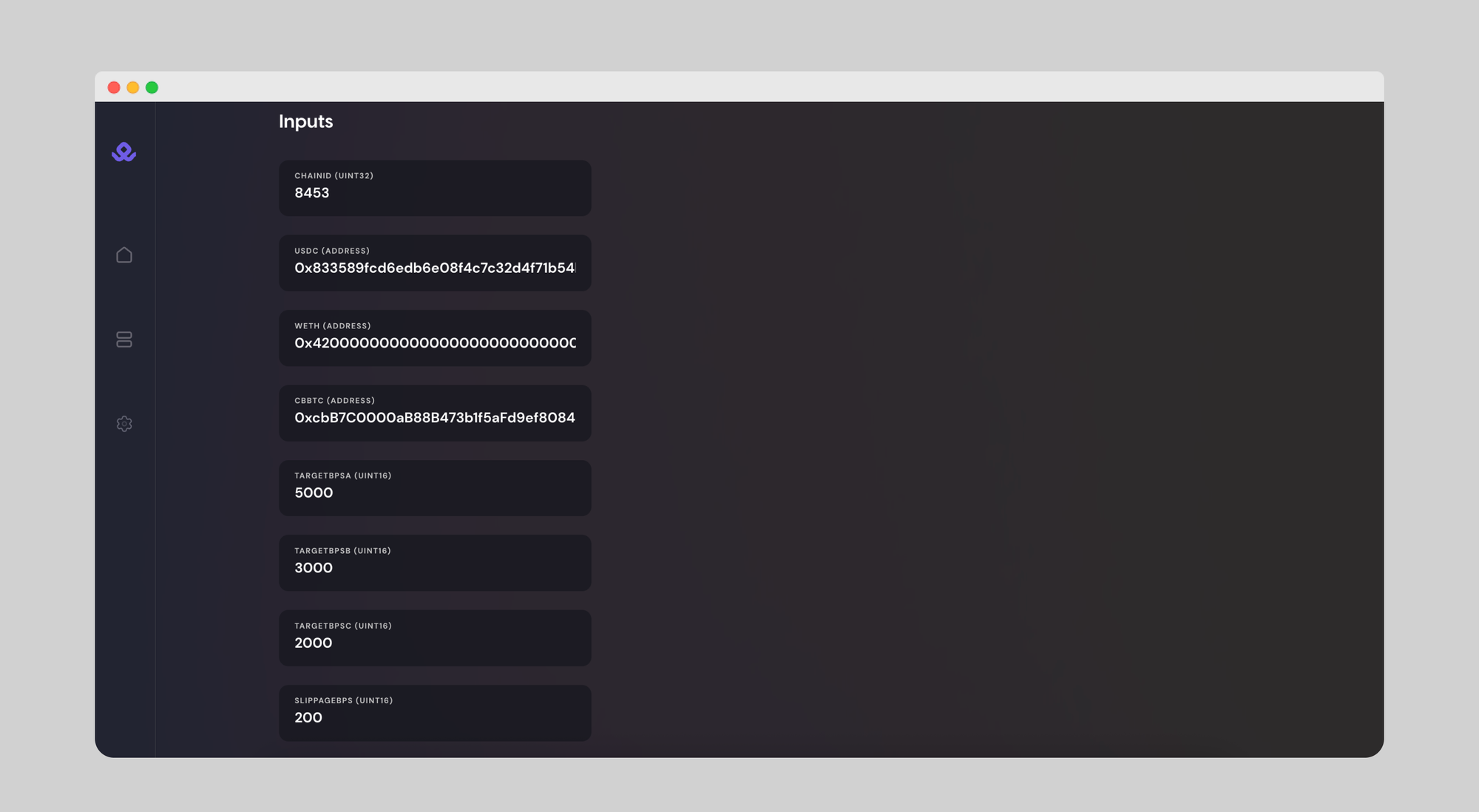
Remember that the targets (A,B,C) must sum a total of 10000 (100% in basis points). In this example:
```tsx
8453 // CHAINID (Base)
0x833589fcd6edb6e08f4c7c32d4f71b54bda02913 // USDC (Base)
0x4200000000000000000000000000000000000006 // WETH (Base)
0xcbB7C0000aB88B473b1f5aFd9ef808440eed33Bf // cbBTC (Base)
5000 // USDC target in basis points (50%)
3000 // WETH target in basis points (30%)
2000 // cbBTC target in basis points (20%)
200 // 2% Slippage in basis point (1% = 100)
```
Finally set the delta (time window to execute), the end date (optional), and sign with your wallet
This signature ensures relayers know the trigger is authorized by the function owner.
You can update or deprecate this trigger at any point in time to reflect changes, without needing to redeploy the function code again. Just sign the new trigger in the explorer, and relayers will pick up the latest version.
You will get a confirmation message: **Function created successfully!**
Below, you can see a summary of the function (how many runs, completions, and errors), as well as the recent executions and all details about it (inputs, trigger, creation date…).
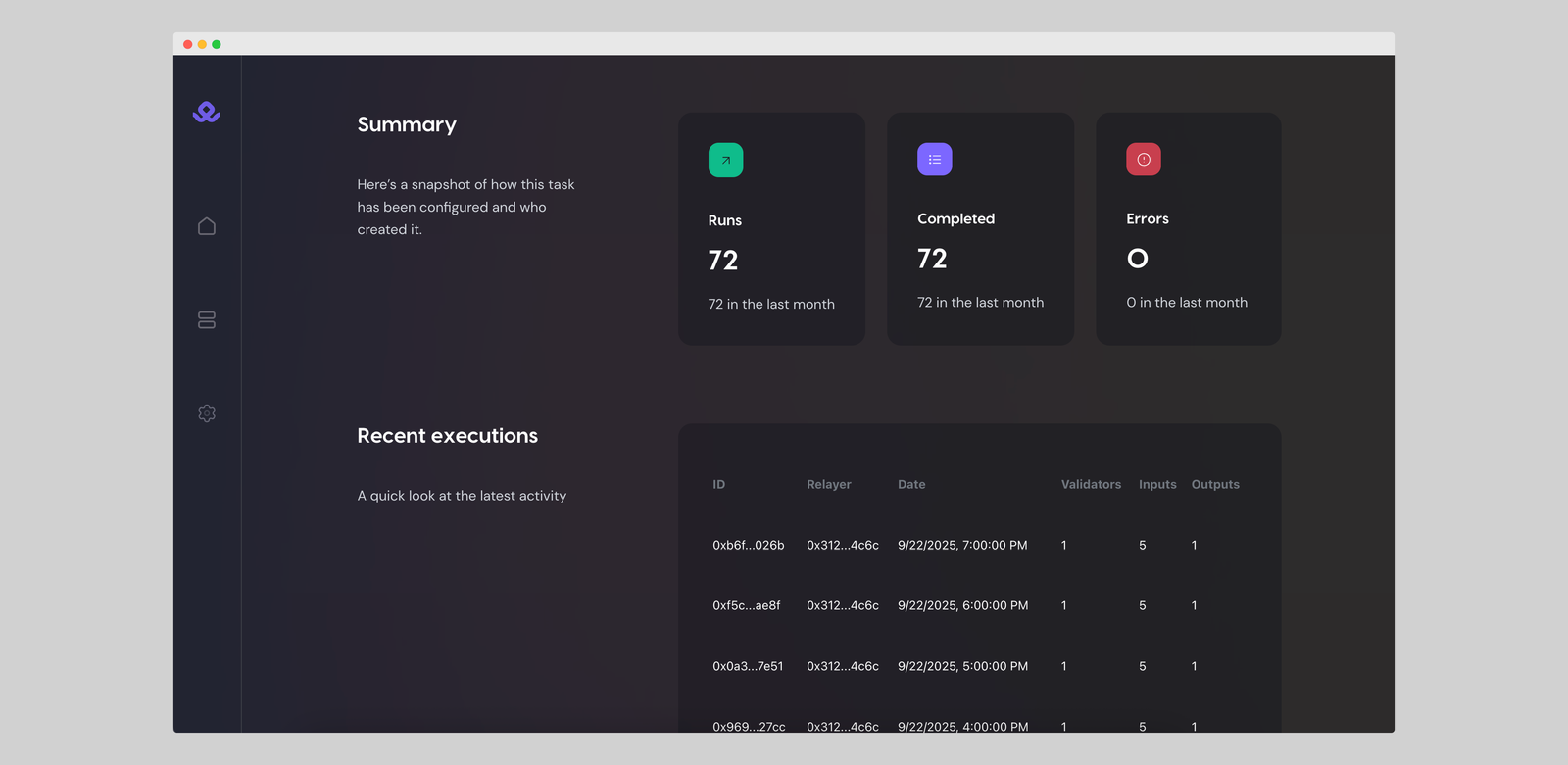
If you press on any of the recent executions, you can get a full execution detail, with info such as inputs, outputs, general details, logs, and more.
You can run multiple functions at the same time, and you can make changes to the configuration by creating a new function, without needing to redeploy the function code again.
### Notes & Variations
You will need:
- **Wallet with funds** (for gas and token approvals)
- **API key** from Mimic Explorer: [https://protocol.mimic.fi/api-key](https://protocol.mimic.fi/api-key)
Remember to give allowance to the Mimic settler for the tokens you want to rebalance.
In this example USDC, WETH, and cbBTC on Base. You can go to the smart contracts on basescan, connect your wallet, and add approval to the Mimic settler: 0x609d831c0068844e11ef85a273c7f356212fd6d1
[USDC](https://basescan.org/address/0x833589fcd6edb6e08f4c7c32d4f71b54bda02913#writeProxyContract) | [WETH](https://basescan.org/address/0x4200000000000000000000000000000000000006#writeContract) | [cbBTC](https://basescan.org/address/0xcbB7C0000aB88B473b1f5aFd9ef808440eed33Bf#writeProxyContract)
- Extend to **N tokens** (you can add more tokens to the rebalancing).
* * *
👉 With this, you’ve got a production-style **wallet rebalancer**: USD-aware, slippage-protected, self-contained, and easy to operate via signed configs in Explorer.
## Wallet Rebalancing is Only the Beginning
With **Mimic Protocol**, setting up a wallet rebalancing strategy is no longer about writing and maintaining bots, custom scripts, or handing funds over to custodial services. You define the rules once in a **function**, sign them, and let Mimic relayers execute on your behalf, directly from **your wallet or treasury**.
But Mimic Protocol can be used for many other use cases around blockchain automation: auto-investing, yield auto-compunding, DCA, fee management, and many more!
Stay tuned for future guides and details on what automation can unlock onchain. Mimic is the automation engine for Web3.
### Get alpha access to Mimic Protocol by clicking below 👇

Start simplifying how you code, execute, and scale blockchain projects. **Let automation handle the busy work while you focus on building.**
🐦 [X (Twitter)](https://x.com/mimicfi) | 📚 [Documentation](https://docs.mimic.fi/) | 📄 [Whitepaper](https://www.mimic.fi/documents/Mimic_Protocol_Whitepaper.pdf) | 💬 [Discord](https://discord.com/invite/qr2ywWuhxe) | 🌐 [Website](https://www.mimic.fi/) | 🌀 [Farcaster](https://farcaster.xyz/mimicfi) | 💼 [LinkedIn](https://www.linkedin.com/company/mimic-finance)
---
# Dollar-Cost Averaging (DCA) Inside any EVM Wallet With Mimic Protocol
> Set up an automated DCA strategy directly inside your EVM wallet using Mimic Protocol.
Published: 2025-09-18 | Updated: 2026-02-02 | Author: Mimic Engineering Team | Tags: Mimic Guides | Source: https://www.mimic.fi/blog/dollar-cost-averaging-dca-inside-any-evm-wallet-with-mimic-protocol
## TL;DR
Set up an automated DCA strategy directly inside your wallet using Mimic Protocol. This guide walks you through creating a function that lets you buy any ERC-20 token for a fixed amount of another ERC20 token periodically in any supported network, with schedules & slippage protection, and deployed to the Mimic Protocol.
## Quick Details
- **Function type:** recurring DCA swap
- **Flow:** swap ERC20 → ERC20 periodically
- **Key inputs:** amount, assets, slippage tolerance, recipient, chain, schedule
This is just an example, Mimic Protocol allows for any type of logic to create a DCA strategy.
## What You Need to Get Started
- [Node.js](https://nodejs.org/en) + [Yarn](https://www.geeksforgeeks.org/installation-guide/how-to-install-yarn-in-macos-ubuntu-windows) installed
- **Wallet with funds**
## Understand the DCA Flow
Dollar-cost averaging means investing a fixed amount of a token at regular intervals:
- In this example, USDC → WETH, in any of the supported chains
- Use slippage protection (e.g. 0.5%)
- Send purchased tokens to your wallet
Mimic Protocol automates this as a **function**:
- Trigger: cron (weekly)
## Define the Function
### 1\. Initialize project
Start a new working directory to develop your function:
```jsx
npx @mimicprotocol/cli init ./my-mimic-function
```
### 2\. Update your `manifest.yaml`
The manifest file provides the configuration for your function, including:
- **Metadata**: Name, description, and version of the function.
- **Inputs**: Parameters required by the function logic.
- **ABIs**: Smart contract ABIs to generate type-safe interfaces for the function.
Save this configuration in the `manifest.yaml` file:
```yaml
version: 1.0.0
name: DCA WETH Purchase
description: Dollar-cost averaging function that swaps USDC to WETH
inputs:
- chainId: uint32
- usdc: address
- weth: address
- amountUsdcDecimal: string
- slippageBps: uint16
- recipient: address
```
You can adapt this to any DCA you want to create, just change USDC and WETH for your desired tokens. Also feel free to delete the "recipient: address" if it's the same wallet.
### 3. Generate types
This steps allows you to validate the manifest definitions and generate the corresponding code to access both your declared inputs and the contract objects for your declared ABIs.
To do this you can run the `codegen` command using the CLI:
```
yarn mimic codegen
```
### 4. Write the function logic
The function logic is implemented in AssemblyScript and must export:
1. **Input type**: The generated `inputs` type from the previous step.
2. **Main function**: The core function logic, which receives the inputs as an argument.
Create a file `./src/function.ts` (or update the pre-existing one), and implement the logic:
```javascript
import { ERC20Token, log, SwapBuilder, TokenAmount } from '@mimicprotocol/lib-ts'
import { inputs } from './types'
export default function main(): void {
// Log input parameters
log.info(
`Starting DCA swap: amountFromToken=${inputs.amount}, slippageBps=${inputs.slippageBps}, chainId=${inputs.chainId}, recipient=${inputs.recipient}`
)
// Create token instances
const tokenIn = ERC20Token.fromAddress(inputs.tokenIn, inputs.chainId)
const tokenOut = ERC20Token.fromAddress(inputs.tokenOut, inputs.chainId)
// Create amount from decimal string and estimate amount out
const amountIn = TokenAmount.fromStringDecimal(tokenIn, inputs.amount)
const expectedOut = amountIn.toTokenAmount(tokenOut).unwrap()
// Apply slippage to calculate the expected minimum amount out
const minAmountOut = expectedOut.applySlippageBps(inputs.slippageBps as i32)
log.info(`Calculated minOut: ${minAmountOut} (equivalent=${expectedOut}, slippageBps=${inputs.slippageBps})`)
// Create and execute swap
SwapBuilder.forChain(inputs.chainId)
.addTokenInFromTokenAmount(amountIn)
.addTokenOutFromTokenAmount(minAmountOut, inputs.recipient)
.build()
.send()
log.info('DCA swap executed successfully')
}
```
You can set up a DCA (Dollar-Cost Averaging) strategy with any ERC-20 token across all supported chains, including ****Arbitrum, Base, Base Sepolia, Ethereum, Gnosis, Optimism, and Sonic****.
This is a USDC → WETH DCA setup. You can replace these with any ERC-20 tokens of your choice (just make sure to specify the correct decimals and token symbol).
Every function is fully customizable, so you can adapt it to your preferred configuration. For details, explore the [Mimic Protocol Library](https://docs.mimic.fi/developers/library).
For now Mimic functions allows creating three types of intents: transfers, generic calls, and crosschain swaps.
**5\. Compile**
The compile process converts your function logic and manifest into deployable artifacts:
- `build/function.wasm` - Compiled WebAssembly binary
- `build/manifest.json` - Processed manifest configuration
Run the compile command:
```
yarn mimic compile
```
By default, outputs are saved in the `build` directory.
Here is an example of the output produced by this command:
```
build/
├── function.wasm # Compiled WASM binary
├── manifest.json # Validated manifest
```
### 6. Deploy your function
This is where you upload your function artifacts to the network so others can discover it. To do this you can run the `deploy` command using the CLI:
```
yarn mimic deploy --api-key [DEPLOYMENT_KEY]
```
You can **generate a deployment key from the protocol app**, where you can login using your wallet.
> Link to Mimic Protocol Explorer: [https://protocol.mimic.fi/](https://protocol.mimic.fi/)

This command will deploy the generated artifacts from the `build` directory by default.
This command will upload your artifacts to the Mimic Registry (which stores them on IPFS) and pin the resultant CID so it can be discovered by others. The CID is also written to `CID.json` in the specified output directory.
### 7. Give allowance to the Mimic settler
**Before you configure your function in the dashboard, you must allow the Mimic Settler contract to spend tokens on your behalf.**
To grant this permission:
1. Open your network’s block explorer and find your spending token contract.
2. Connect your wallet.
3. Set the Mimic Settler as the spender address.
4. Approve the contract so it can manage the tokens needed for your function.
Mimic Settler contract:
```
0x609d831c0068844e11ef85a273c7f356212fd6d1
```
In this example, we are going to be using USDC on Base. You can go to the smart contract on basescan, click on "write as proxy", connect your wallet, and add approval to the Mimic settler.
[https://basescan.org/address/0x833589fCD6eDb6E08f4c7C32D4f71b54bdA02913#writeProxyContract](https://basescan.org/address/0x833589fCD6eDb6E08f4c7C32D4f71b54bdA02913#writeProxyContract)
The spender is the Mimic settler, and the value depends on the token you want to use in uint256 (USDC has 6 decimals, so the amount + 6 extra zeros).
If you want to allow 20 USDC spending limit, you would write 20000000 (20 + 6 zeroes). Most explorers allow to add them easily as shown below.
### 8. Configure your function
After deploying your function, you can now add a trigger, to tell which trigger relayers should use to run your function. This means defining the parameters declared in your `manifest.yml` file. This is done in the [explorer UI](https://protocol.mimic.fi/) where you will be requested to sign your trigger with your wallet or with the SDK.

1. Open the explorer and locate the function you just deployed under the functions section.
2. Add or edit your trigger parameters
3. Sign the new trigger
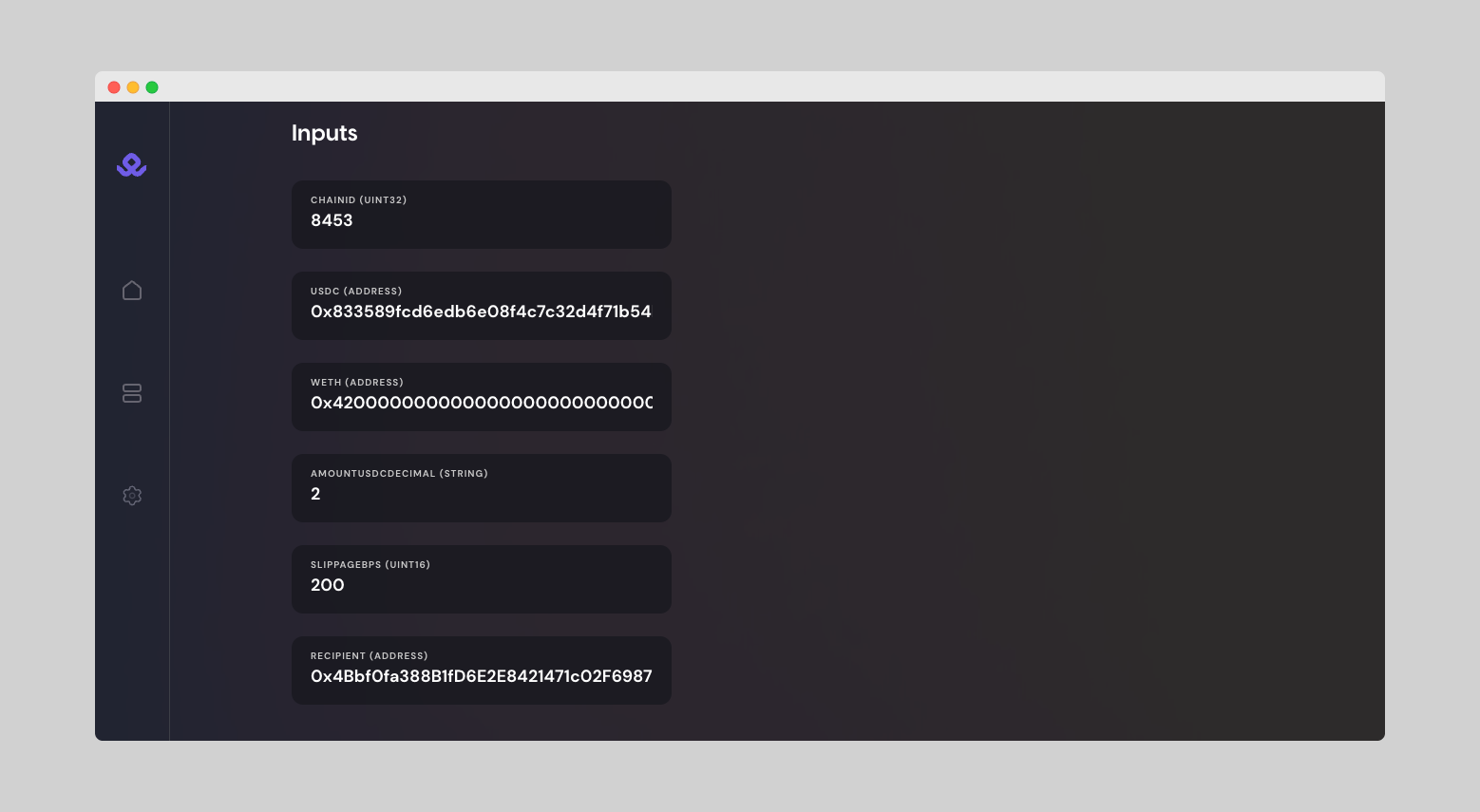
In this example:
```
8453 // CHAINID (Base)
0x833589fcd6edb6e08f4c7c32d4f71b54bda02913 // USDC (Base)
0x4200000000000000000000000000000000000006 // WETH (Base)
2 // AmountUSDDecimal, in this example 2 USDC
200 // 2% Slippage in basis point (1% = 100)
```
Then set the the execution fee limit (you can set 0, which means no limit), the execution mode, and the the cron trigger:
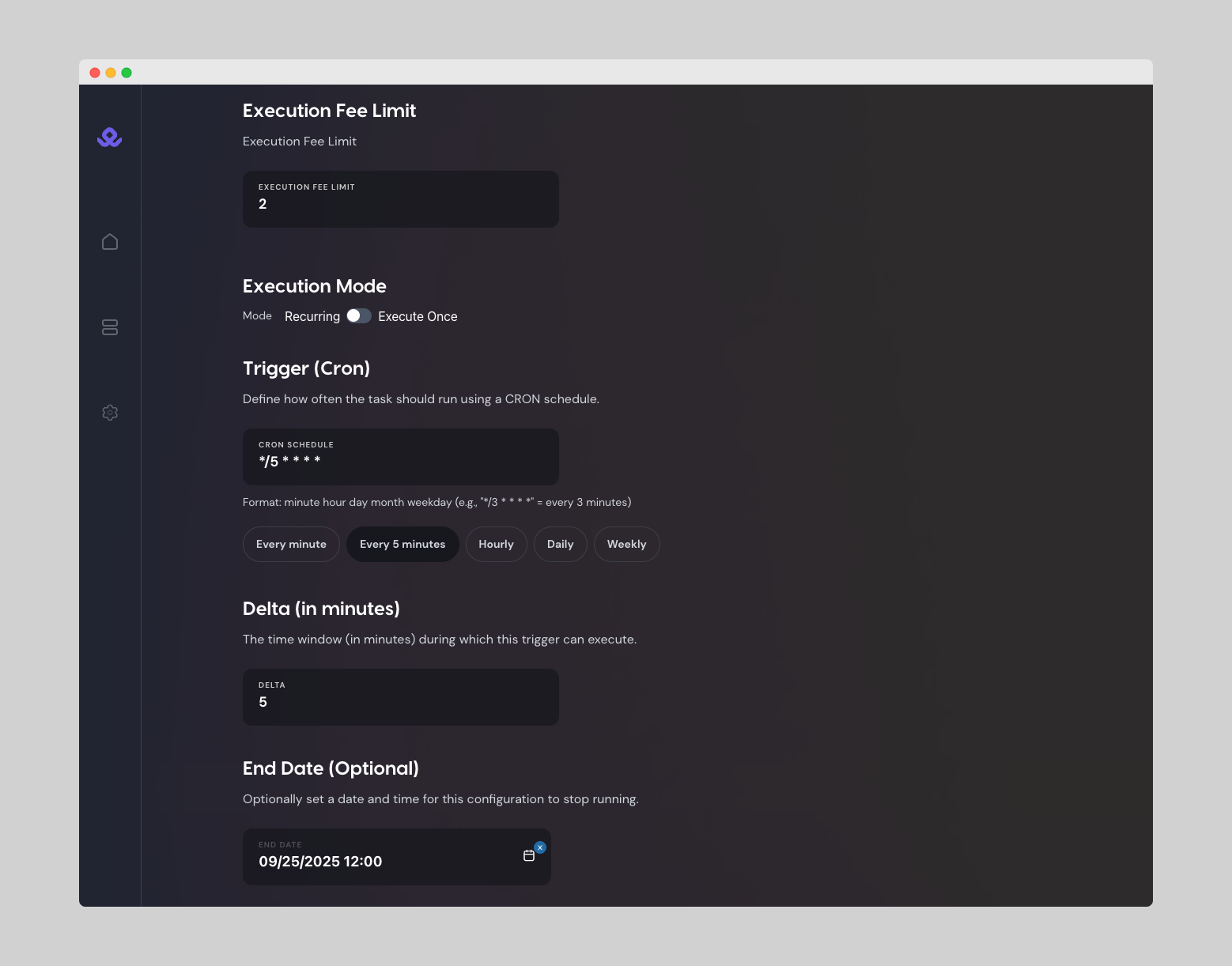
Finally set the delta (time window to execute), the end date (optional), and sign with your wallet
This signature ensures relayers know the trigger is authorized by the function owner.
You can update or deprecate this trigger at any point in time to reflect changes, without needing to redeploy the function code again. Just sign the new trigger in the explorer, and relayers will pick up the latest version.
You will get a confirmation message: **Function created successfully!**
Below, you can see a summary of the function (how many runs, completions, and errors), as well as the recent executions and all details about it (inputs, trigger, creation date…).
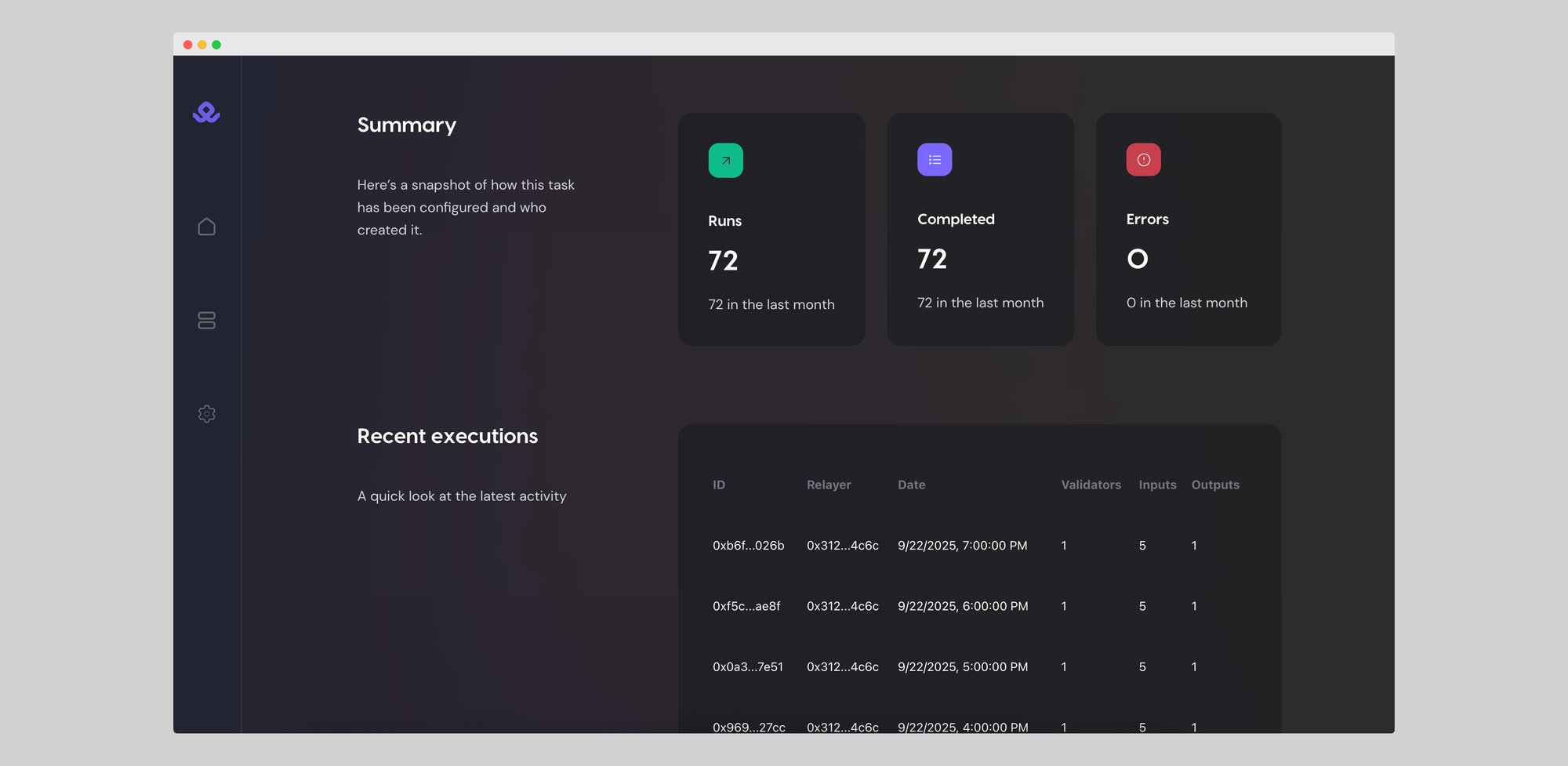
If you press on any of the recent executions, you can get a full execution detail, with info such as inputs, outputs, general details, logs, and more.
You can run multiple functions at the same time, and you can make changes to the configuration by creating a new function, without needing to redeploy the function code again.
### Notes & Variations:
Remember to give allowance to the settler of the token you are going to be spending. In this example USDC, you can go to the [smart contract on basescan](https://basescan.org/address/0x833589fCD6eDb6E08f4c7C32D4f71b54bdA02913#writeProxyContract), connect your wallet, and add approval to the Mimic settler: 0x609d831c0068844e11ef85a273c7f356212fd6d1
Variations:
- Change `usdc` and `weth` addresses for any token pair (ERC-20 in supported networks).
- Adjust `cron` schedule (e.g. daily, biweekly).
- You can add `recipient` to the manifest to send into a different wallet.
* * *
👉 With this setup, you’ve created a **repeatable DCA flow inside your wallet** using Mimic Protocol.
## DCA is Only the Beginning
With **Mimic Protocol**, setting up a DCA strategy is no longer about writing and maintaining bots, custom scripts, or handing funds over to custodial services. You define the rules once in a **function**, sign them, and let Mimic relayers execute on your behalf, directly from **your wallet or treasury**.
But Mimic Protocol can be used for many other use cases around blockchain automation: auto-investing, yield auto-compunding, wallet rebalancing, fee management, and many more!
Stay tuned for future guides and details on what automation can unlock onchain. Mimic is the automation engine for Web3!
### Get alpha access to Mimic Protocol by clicking below 👇

Start simplifying how you code, execute, and scale blockchain projects. **Let automation handle the busy work while you focus on building.**
🐦 [X (Twitter)](https://x.com/mimicfi) | 📚 [Documentation](https://docs.mimic.fi/) | 💬 [Discord](https://discord.com/invite/qr2ywWuhxe) | 🌐 [Website](https://www.mimic.fi/) | 🌀 [Farcaster](https://farcaster.xyz/mimicfi) | 💼 [LinkedIn](https://www.linkedin.com/company/mimic-finance)
---
# Automation Spotlight: How Mimic Fee Collector Empowers Teams to Manage Crosschain Fees
> Today’s multi-chain market results in significant operational challenges around the management of revenue fees. Our fee collection solution empowers teams to automate the process: consolidating assets from multiple chains into a single token and destination, in a secure manner.
Published: 2025-09-11 | Updated: 2025-09-24 | Author: Mimic Engineering Team | Tags: Fee Collector | Source: https://www.mimic.fi/blog/automation-spotlight-how-mimic-fee-collector-empowers-teams-to-manage-crosschain-fees
When Web3 protocols and applications generate revenue fees across multiple chains and tokens, the finance and operations teams need to convert all those fees into something more manageable, such as stablecoins, to pay salaries, distribute profits, and pay taxes, among other uses.
The more networks, tokens, and wallets involved in the process, the more complicated it becomes. There are several steps involved: collecting the fees, swapping them, bridging, and distributing all those tokens into one or multiple wallets.
## Why Managing Fees Manually is Difficult and Time-consuming
Today’s multi-chain market results in significant operational challenges around the management of revenue fees:
- Complexities due to the diversity of tokens, prices, and networks
- One of our customers has regularly more than 2,700 tokens only in the Polygon network
- Manual operations increase the risk of mistakes and delays
- Another customer automated only 80% of their flow, and they still made a mistake in the final step of the workflow, causing a loss of funds
- “Long-tail token problem”: only selling the main tokens in order to avoid the tedious task of selling every single token manually
- A lot of clients only sold major tokens (ETH, USDC, USDT, WBTC, etc.), which made up 70% of the volume, wasting a high percentage of potential revenue (30% of volume) and leaving it in illiquid tokens that lost value over time
- Requires constant checks and vigilance over market conditions
- Some of our clients used to spend too much on gas costs while manually doing this, due to bad operation timing (e.g. needing salaries at the end of the month)
- Operational overhead and security risks add up fast
- Time-consuming and monotonous, preventing valuable team members from focusing on more critical engineering tasks
- For example, the Balancer team used to spend 8–10 hours every two weeks on v2 to swap fee tokens manually
> _“Integrating Mimic's Fee Collector into our operations has been a game-changer. It completely automated how we handle fee management across multiple integrations, eliminating hours of manual work.”_
> **Ledger**
## Introducing Mimic Fee Collector
Our fee collection solution empowers teams to automate the process: consolidating assets from multiple chains into a single token and destination, in a secure manner.
**Collects your fees anywhere → swaps them at the best price and in the correct time → bridges with complete security → withdraws to your destination address/es in one token (instead of 1000s).**
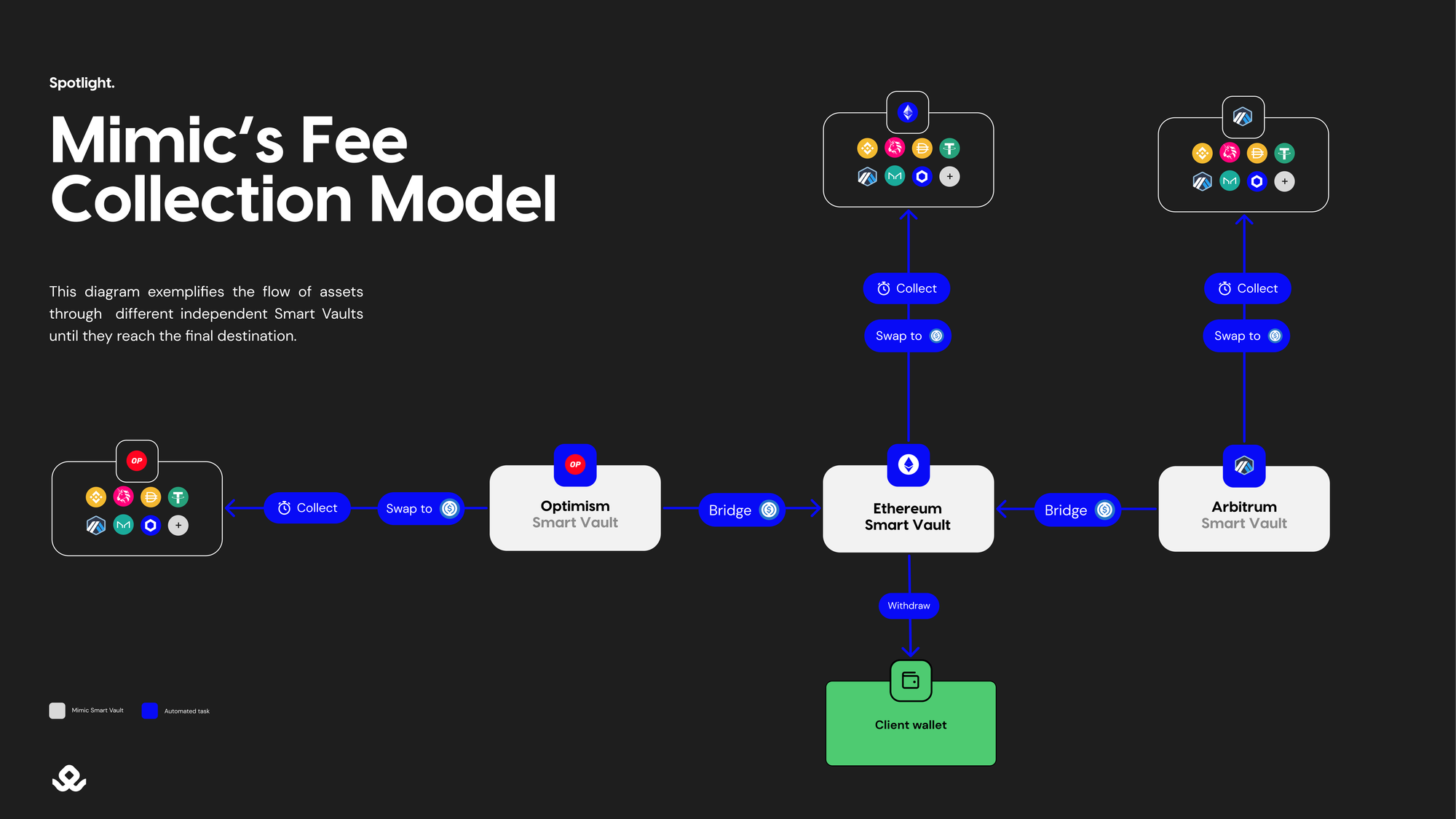
End-to-end automation that adapts to every client’s specific use case.
Different than protocols that might share the same smart contracts to manage the assets of several clients (e.g., Pools), **Mimic deploys a dedicated environment for each client:**
- The privacy feature adds a higher level of security, as only authorized entities can access these smart contracts, thereby shielding client assets
- Customers always retain full control over their assets since each environment is fully non-custodial and isolated
- This approach ensures operational efficiency while maintaining trust and reliability
> _“Mimic \[…\] manages our fee collection with precision and reliability, eliminating manual overhead and reducing operational risk.”
> **Trust Wallet**_
With over $7B of value processed, **Mimic Fee Collector** is a battle-tested and reliable solution for onchain fee management:
- Trusted by leaders such as Balancer, Ledger, Trust Wallet, Velora, and more
- Live across all major EVM networks and Solana
- Offers extensive reporting, giving businesses the information they need to make better decisions
- Provides world-class service for customer support, reporting, and ongoing maintenance
> _“The comprehensive reporting adds another layer of confidence for our team and stakeholders.”_
> **Ledger**
> _“Their team continues to provide top-tier support whenever we need it.”_
> **Trust Wallet**
## How Customers Managed Onchain Fees Before Mimic
Fee management was typically a task assigned to the finance team, often without in-depth knowledge of crypto markets, as they needed to handle revenue and financial projections. Before adopting Mimic Fee Collector, many teams relied on a mix of manual transactions, internal scripts, and centralized providers to manage their fee operations.
1. Most teams were doing **manual fee collection**, tracking down the revenue tokens across wallets, executing swaps, bridging, and transferring repeatedly
2. Others built custom in-house tools or scripts that required constant maintenance, engineering time, and lacked the flexibility to adapt to evolving use cases.
3. Lastly, some relied on centralized services that introduced security vulnerabilities and access control problems.
> _“This helped us scale the business and improve our financial operations.”_ **Velora (formerly ParaSwap)**
All these approaches worked on their own, but were time-consuming, error-prone, difficult to scale as protocols grew across chains, or involved third parties temporarily taking control over company assets.
## Why Switch to Mimic Fee Collector Instead of Handling Fee Collection In-house
We've spent years helping teams automate fee collection across all kinds of setups. That experience lets us move fast, adapt to any business requirements, and deliver a solution that just works. No matter how complex the need, our system is built for customization, security, and scale, so you can focus on strategy, while we handle the operations.
Aside from execution, our fee collection solution helps teams streamline their management flow, providing structured data for each step of the process. Clients can **select from multiple of parameters** to customize their environment tasks, while always remaining in control of their assets.
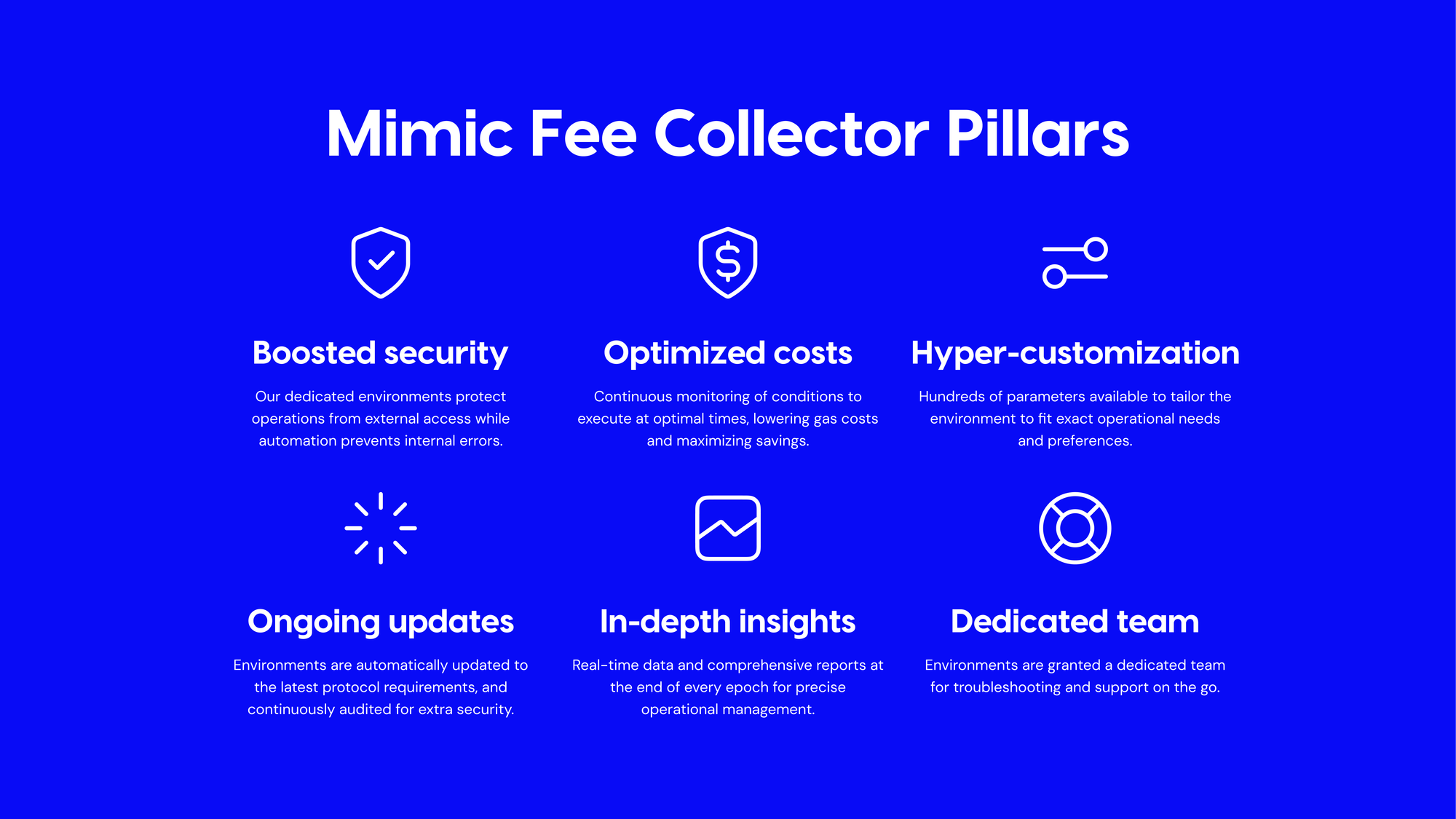
The Mimic team configures shared parameters, including token management, slippage tolerance, transaction limits, transaction cost thresholds, fee claiming, permissions, execution settings, and more, **based on customer instructions**.
Clients also have the flexibility to set thresholds, slippage, or timing themselves, allowing detailed customization and strategic oversight. It’s worth noting that all these parameters can be changed anytime, based on the client/business needs.
Every single one of our customers has access to a world-class integration team and customer support, addressing any issue that may arise and ensuring every dedicated environment remains up to date for optimal performance.
> _“The ongoing support from the Mimic team is impeccable — working with them is a sheer pleasure.”_ **Velora (formerly ParaSwap)**
> _“Their consistent professionalism, reliable execution, and seamless integration have made Mimic a trusted part of our infrastructure.”_ **Balancer**
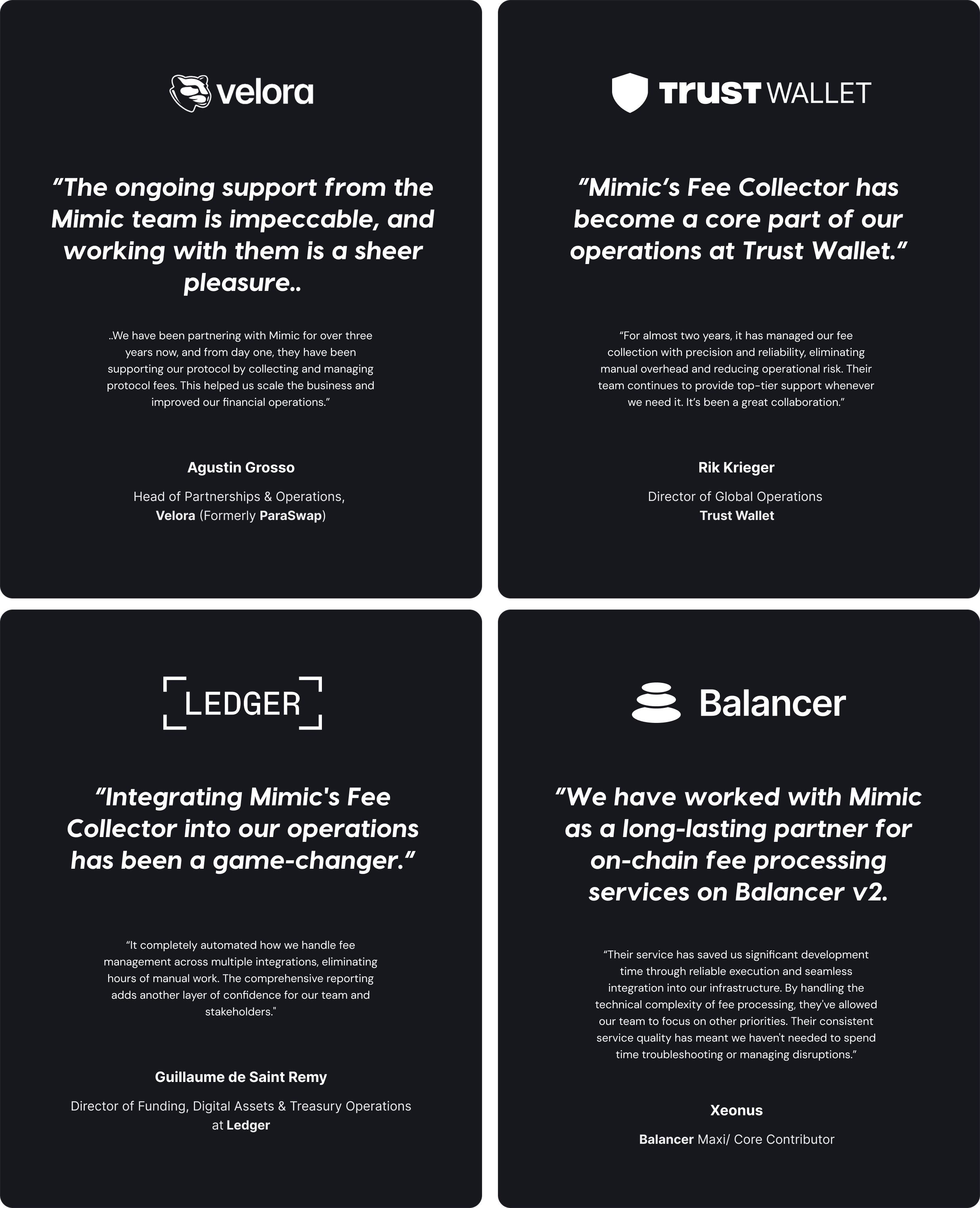
## What Our Customers Say (Full Testimonials)
## Ready to Automate your Fee Collection?
**Still handling fees manually?** Let us take it from here.
Join leading teams using Mimic Fee Collector to automate fee management across chains.
👉 [Let’s talk](https://www.mimic.fi/contact)
[Learn more](https://www.mimic.fi/fee-collector) | [Supported networks](https://www.notion.so/Supported-networks-Fee-Collector-24ef0204dbef4cbeb119273be01092b2?pvs=21) | [Fee Collector blog](https://www.mimic.fi/blog/mimic-fee-collector-automate-your-onchain-fee-management)
---
# How Mimic Fee Collector Could Have Avoided Coinbase’s $550K MEV Exploit
> Even the best-prepared teams in crypto are not immune to mistakes. This week, Coinbase, one of the industry’s largest and most experienced players, lost around $550,000 when its corporate wallet mistakenly approved tokens to 0x’s swapper contract. An opportunistic MEV bot, long waiting for this type of misstep, instantly drained the authorized assets.
Looks like @coinbase was recently drained of ~$300,000 after using @0xProject swapper incorrectly.
They approved all the tokens accrued as fees
Published: 2025-09-09 | Updated: 2025-09-10 | Author: Mimic Engineering Team | Tags: Fee Collector | Source: https://www.mimic.fi/blog/how-mimic-fee-collector-could-have-avoided-coinbases-550k-mev-exploit
Even the best-prepared teams in crypto are not immune to mistakes. This week, Coinbase, one of the industry’s largest and most experienced players, lost around $550,000 when its corporate wallet mistakenly approved tokens to 0x’s _swapper_ contract. An opportunistic MEV bot, long waiting for this type of misstep, instantly drained the authorized assets.
No customer funds were affected, and Coinbase acted quickly to secure its wallets. But the event is a reminder that **token approvals are one of the most overlooked security risks in DeFi.**
You can read an article by Cointelegraph about it here: [https://cointelegraph.com/news/coinbase-0x-contract-error-mev-bot-300k-loss](https://cointelegraph.com/news/coinbase-0x-contract-error-mev-bot-300k-loss)
## Why Token Approvals Are Tricky
Onchain approvals are designed to let smart contracts spend tokens on your behalf. But when approvals are given to contracts that shouldn’t hold them (like a swapper contract) they effectively hand over the wallet funds. Because these approvals are public and permissionless, anyone can call the contract and drain the funds once the allowance exists.
The Coinbase case shows that:
- Errors don’t have to be malicious exploits, misconfigurations alone are enough.
- MEV bots are always watching, ready to execute when high-value wallets slip.
- Once approvals are live, revoking them is usually too late.
Whether the authorization was made manually or through code doesn’t matter. **The lesson is that approvals need continuous control, monitoring, and safeguards.**
## Introducing Mimic Fee Collector
At Mimic, we designed the Mimic **Fee Collector** to handle exactly these kinds of operational challenges for teams, DEXes, and wallets:
Instead of manually managing dozens of fee streams across networks and tokens, teams can consolidate their fees into one asset and address/es with secure automation. Automated **collect, swap, bridge, and withdraw** tasks, always executed within their chosen rules.
- **Oracles validate conditions** before any action (like approvals, swaps, or bridges) takes place. This prevents unsafe or unintended operations from executing.
- **Safeguards enforce limits** such as allowed tokens, slippage boundaries, gas price caps, and destination addresses. No task runs outside of user-defined parameters.
- **Dedicated SmartVault environments** keep operations isolated, non-custodial, and configurable per client.
- **Revocation and renewal of approvals** can be automated, so allowances are never left open-ended.
## How Mimic Fee Collector Could Have Prevented Coinbase’s $550k MEV Exploit
Mimic Fee Collector could have prevented Coinbase’s $550K loss by removing the need for broad ERC-20 approvals to unsafe contracts in the first place. With Fee Collector, all fee operations (collecting, swapping, bridging, and withdrawing) are executed through **dedicated SmartVaults in private environments**, where permissions, token approvals, and execution parameters are tightly controlled and only exposed under user-defined safeguards.
Instead of granting unlimited allowances to a permissionless contract like 0x Settler, Coinbase’s fee wallet would have routed all operations through Mimic’s automated workflows, which enforce role-based permissions, slippage limits, gas controls, and destination whitelists. This design ensures that **no external actor could exploit approvals**, while still allowing fees to be consolidated, swapped, and bridged automatically.
> In short, Fee Collector’s trustless, non-custodial automation would have eliminated the human error of misconfigured approvals that MEV bots exploited, protecting Coinbase from a costly “drained by design” mistake.
## Why Security Safeguards Matter More Than Ever
For Coinbase, $300,000 is a small loss. But for most teams, a similar mistake could be critical. The incident is a timely reminder that operational fragility is real, even at the top.
As DeFi grows, the complexity of fee management and token flows across chains only increases. Relying on manual processes or fragile scripts is not enough. Exchanges, wallets, and protocols need **automation with safeguards:** systems that check, validate, and enforce safe behavior before mistakes become losses.
## Start Using Automation for Fee Management
**Still handling fees manually?** Let us take it from here.
Join leading teams using Mimic Fee Collector to automate fee management across chains:
👉 Let’s talk: [https://www.mimic.fi/contact](https://www.mimic.fi/contact)
[Learn more](https://www.mimic.fi/fee-collector) | [Supported networks](https://www.notion.so/Supported-networks-Fee-Collector-24ef0204dbef4cbeb119273be01092b2?pvs=21) | [Fee Collector blog](https://www.mimic.fi/blog/mimic-fee-collector-automate-your-onchain-fee-management)
---
# What is Mimic Protocol?
> Mimic Protocol is the automation layer for Web3. Automate everything onchain: any tasks, any logic, with crosschain execution.
Published: 2025-08-29 | Updated: 2026-02-23 | Author: Mimic Engineering Team | Tags: Mimic Platform | Source: https://www.mimic.fi/blog/what-is-mimic-protocol
Mimic Protocol is the automation layer for Web3. Open and secure automation for builders, DeFi teams, AI agents, developers, wallets, and beyond.
Automate everything onchain: any functions, any logic, with crosschain execution. Programmable and non-custodial to help you combine simple actions (like swaps, bridging, claiming or staking) with custom conditions (balances, prices, dates, and more), taking your onchain operations to the next level.
The end goal is to make automation accessible to everyone (from developers to product managers and even finance teams) while maintaining precision, transparency and scalability in execution.
At a high level, Mimic lets you “set it and forget it” for onchain workflows. Builders can define complex conditional operations in code (for example, a multi-step DeFi strategy or periodic portfolio rebalancing) and the protocol will handle the rest – fetching data, checking conditions and executing transactions when needed.
## Why does it matter?
Web3 wants to scale, but it lacks automation standards
Every industry in the world has grown with automation. But for some reason, Web3 still relies on manual operations. Imagine a DAO wants to keep their treasury balanced at 60% stablecoins, 30% ETH, and 10% DeFi tokens. Doing this manually looks like:
> Check the portfolio composition → Calculate deviations from the target allocation → Decide what to sell and buy → Connect to a DEX → Approve tokens for trading → Execute swaps (sometimes across multiple chains) → Bridge assets if needed → Verify new balances → Repeat every week (or more often if markets move).
Add monitoring gas prices, interacting with multiple protocols (each with its own interface and requirements) or getting gas fees, _and things can start getting intense._ If this seems like too many steps, that’s because it is. Now imagine thousands of transactions, across several blockchains, and adding more complex actions like staking, swapping, or withdrawing assets.
One portfolio rebalance is doable. But try doing it for multiple treasuries, vaults, or funds, and it quickly becomes **operationally impossible.** Doing things manually can only get you so far.
Web2 already has standards for automation. **We want to bring the same level of scalability to Web3:** a simple, easy way to integrate automation into apps, wallets, and protocols.
## How does Mimic Protocol work?
> **TLDR:** select the operations, set the triggers, let the protocol automate the execution.
Mimic Protocol offers developers a **“plug-and-play” solution to automate any blockchain operations** (like swaps, transfers, staking) with different triggers, such as onchain events (even across chains), chronological schedules (times & dates), and other types of custom conditions (like balance thresholds).
It allows developers to:
- Decide what they want to automate, and Mimic Protocol executes according to their exact conditions, in a reliable, secure, and decentralised manner.
- Implement automation directly in their apps or backend, offering them flexibility to build and scale exactly what they need.
- Set how long to run their automation, and as long as the conditions are met, Mimic Protocol will execute the operations 24/7.
**Mimic Protocol is not an L1 or L2**, but rather a chain-agnostic protocol, helping connect multiple actions on multiple chains. Users can decide what they want to automate, and Mimic Protocol executes functions 24/7 according to the exact conditions, with complete reliability, security, and decentralization.
## Mimic Protocol technical architecture
Mimic is built with a three-layer architecture, each layer focusing on a distinct part of the automation pipeline. This modular design allows the protocol to maintain clarity of roles and responsibilities, enhancing both security and scalability. The layers are:
(1) the Planning Layer where functions are defined and evaluated
(2) the Execution Layer where intents (function outputs) are processed and fulfilled and
(3) the Security Layer which finalizes transactions and enforces safeguards
Each layer involves specific participants and components that work together to ensure deterministic execution and robust handling of user operations
1. **Planning Layer**
Allows you to define and schedule functions with precise triggers (time-based, event-based, or custom conditions). Multiple independent relayers fetch data from oracles, validate conditions, and keep everything deterministic.
2. **Execution Layer**
Transforms user functions into “intents” and coordinates a network of solvers in a competitive auction-like environment to find the most efficient, reliable proposal. Think of it as a decentralized “function runner” that ensures you get **the best** execution outcome.
3. **Security Layer**
The final on-chain contract that validates a solver’s proposed outcome against your **user-defined safeguards,** and ensures only authorized, expected actions take place. It’s your safety net, enforcing the logic you originally set.
With Mimic, you get the benefits of automation without surrendering your private keys or trusting a single intermediary.
You can learn more about the full protocol architecture in our documentation: [https://docs.mimic.fi/developers/architecture](https://docs.mimic.fi/developers/architecture)
## Who is it for?
Mimic Protocol is designed for a wide range of Web3 audiences, from developers and dApp teams to institutional treasuries and autonomous agents, all needing reliable, scalable, and secure automation. Here’s a breakdown of the key protocol users:
- **Web3 developers**: Developers can define functions using custom logic, integrate automation into smart contracts, and interact with Mimic through APIs and SDKs to build robust automation layers into their apps, protocols, or bots.
- **Web2 developers entering Web3**: For developers without deep Solidity or smart contract experience, Mimic abstracts away much of the blockchain complexity. It provides intuitive scripting environments, pre-built templates, and strong guardrails, making it easy to set up and deploy automation logic without writing low-level smart contract code.
- **AI agents & autonomous systems**: AI and offchain agents can leverage Mimic to interact with blockchain infrastructure safely. Thanks to strict safeguard enforcement, agents can execute operations like swaps, staking, or bridging without risking asset loss or unauthorized behavior, enabling the rise of “AI-native” DeFi execution models.
- **Treasury managers & financial teams**: For DAOs, DeFi protocols, or Web3 companies managing multi-chain treasuries, Mimic enables automation of key workflows, such as rebalancing portfolios, moving assets between networks, distributing funds, or executing market-driven strategies, all with full control over timing, thresholds, and security rules.
- **Wallets & superapps**: Mimic allows wallets to offer embedded automation features like DCA, auto-investment, rewards compounding, or conditional staking. These can be added via SDKs or function templates, giving users features without the complexity of writing custom contracts.
- **DeFi protocols & DAOs**: Protocol teams can automate backend operations like fee collection, token distribution, vault strategies, and even airdrops, improving operational efficiency while preserving decentralization.
- **App builders & infrastructure teams**: Teams building Web3 applications or services can use Mimic to handle operational logic in the background, like reacting to user activity, automating liquidity provision, or scheduling time-based actions, letting them focus on product development, not execution pipelines.
- **Crosschain platforms**: Since Mimic is chain-agnostic and supports cross-chain intents, it's a powerful tool for teams operating across multiple networks. It handles bridging, token standardization, and conditional execution, solving key interoperability challenges.
- **Governance & DAO coordinators**: Mimic allows for automated proposal execution, periodic rewards distribution, or milestone-based funding, all configured through community-approved parameters, ensuring transparency and execution fidelity.
In essence, Mimic is for anyone who needs automation in Web3 but refuses to compromise on control, security, or flexibility.
## Real use cases with Mimic Protocol
**AI agents:** Mimic lets AI handle automation without letting it run wild, so you get the benefits of innovative, proactive execution without risking full wallet compromise.
**Treasury/asset management:** Automate treasury strategies, including portfolio rebalancing, asset allocation, and liquidity optimization, across multiple chains and assets.
**Automated vaults:** automate DeFi strategies that include any function, such as investing, staking, swapping, bridging, or any smart contract call, with custom parameters and complete user control.
**Internal operations:** handle backend workflows like function execution, input validation, and safeguarding logic with deterministic and decentralized automation.
**Fee collection:** automate the secure aggregation, conversion, and distribution of protocol fees across networks
**Airdropper solution:** enable token airdrops based on preset triggers and logic, ensuring controlled, repeatable, and gas-efficient distribution campaigns.
**Account topper:** by monitoring balances and executing refills upon thresholds, automate topping up accounts or wallets across chains with minimal manual oversight.
**Recurring payments:** through scheduled or condition-triggered functions, support automated periodic payments or billing flows with precision and reliability.
In a world where technology scaled with automation, Mimic Protocol brings new standards to Web3.
### Get alpha access to Mimic Protocol by clicking below 👇

Start simplifying how you code, execute, and scale blockchain projects. **Let automation handle the busy work while you focus on building.**
🐦 [X (Twitter)](https://x.com/mimicfi) | 📚 [Documentation](https://docs.mimic.fi/) | 📄 [Whitepaper](https://www.mimic.fi/documents/Mimic_Protocol_Whitepaper.pdf) | 💬 [Discord](https://discord.com/invite/qr2ywWuhxe) | 🌐 [Website](https://www.mimic.fi/) | 🌀 [Farcaster](https://farcaster.xyz/mimicfi) | 💼 [LinkedIn](https://www.linkedin.com/company/mimic-finance)
---
# Why Trustless Automation Matters in Web3
> Manual processes don’t scale. In traditional tech stacks, we rely on automated pipelines and scheduled tasks. Why should blockchain be any different?
Published: 2025-08-18 | Updated: 2025-08-29 | Author: Mimic Engineering Team | Tags: Onchain Automation, Mimic Platform | Source: https://www.mimic.fi/blog/why-trustless-automation-matters-in-web3
Manual processes don’t scale. In traditional tech stacks, we rely on automated pipelines and scheduled tasks. Why should blockchain be any different?
Modern software development embraces automation everywhere: from CI/CD pipelines to cloud infrastructure. Yet in blockchain, many recurring tasks still rely on human intervention, such as manually executing scripts, monitoring market conditions, or toggling smart contracts. This approach limits Web3’s potential, because manual effort is prone to error, delay, and unpredictability.
At a time when developers are building advanced DeFi protocols and crosschain apps, the tools we use to manage onchain actions still feel like the early days of Web2: fragmented, fragile, and frustrating.
**Trustless automation** changes that. It provides a secure and decentralized way to schedule and execute onchain actions, removing the need to babysit your transactions or rely on a single, centralized service.
And that’s where **Mimic Protocol** comes in. We’re building **the automation layer for Web3** that helps you handle **routine or complex tasks** onchain, just as seamlessly as you’d run scheduled jobs in AWS or any other enterprise-grade infrastructure.
## The State of Automation in Blockchain: A Decade Behind
In the broader tech world, companies use services like AWS, Kubernetes, or specialized DevOps tools to keep their workloads running smoothly, even when employees are offline.
In Web3, however, automation is still **underdeveloped**. Existing solutions often rely on:
- **Centralized operators** you must trust not to censor or misfire your transactions.
- **Manual tasks** that force you or your dev team to be on-call for routine updates.
- **Semi-closed frameworks** that don’t offer the same transparency or composability as onchain solutions.
Moreover, each chain or layer often has its own tooling, making crosschain operations cumbersome. The result? Builders who want enterprise-level automation face a tangle of ad-hoc scripts, partial solutions, or manual processes.
Despite blockchain’s innovation around decentralization, many Web3 operations are still manual. Developers maintain bots, cron jobs, and backend scripts just to keep things running. Teams must constantly monitor markets, approve transactions, and move funds—especially when working across multiple chains.
Compare this with **Web2 infrastructure**, where automation is a given:
- Cloud engineers rely on autoscaling, uptime monitoring, and scheduled jobs.
- Financial services use algorithms to move trillions in daily volume automatically.
- DevOps teams deploy changes with zero downtime via CI/CD pipelines.
The irony is clear: blockchains were designed to eliminate intermediaries, yet we often end up playing the middleman for our own systems.
## Why Trustless Automation Matters
Automation is about **efficiency**: reducing repetitive tasks, minimizing human errors, and enabling 24/7 operations. But in a **trustless** environment, it also needs to ensure:
### Decentralization
No single operator can censor or commandeer your scheduled tasks. Multiple independent actors verify data and process execution, mirroring the ethos of blockchain.
### Security & Transparency
Clear onchain records of who, when, and how tasks are triggered. Automated actions must respect user-defined safeguards.
### Scalability
As your onchain workflow grows—whether it’s supply chain tracking, decentralized finance, treasury management, or enterprise use cases—human oversight can’t keep up. Automation helps scale tasks seamlessly.
### Cost Optimization
With the right incentives, tasks can execute at optimal times or under certain cost conditions (like gas fee thresholds), reducing operational expenses for the end user.
Onchain Automation isn't just about convenience, it's about resilience, decentralization, safety, and focusing on building instead of time-consuming operations.
## Introducing Mimic: A High-Level Teaser
Mimic Protocol is engineered to **standardize and scale** automation for Web3. We’re building it around three foundational layers—**Planning**, **Execution**, and **Security**—to ensure every step from “task definition” to “onchain finalization” is handled **transparently** and **securely**.
### Planning Layer
Allows you to define and schedule tasks with precise triggers (time-based, event-based, or custom conditions). Multiple independent relayers fetch data from oracles, validate conditions, and keep everything deterministic.
### Execution Layer
Transforms user tasks into “intents” and coordinates a network of solvers in a competitive auction-like environment to find the most efficient, reliable proposal. Think of it as a decentralized “task runner” that ensures you get **the best** execution outcome.
### Security Layer
The final onchain contract that validates a solver’s proposed outcome against your **user-defined safeguards**—and ensures only authorized, expected actions take place. It’s your safety net, enforcing the logic you originally set.
With Mimic, you get the benefits of automation without surrendering your keys or trusting a single intermediary.
## A Foundation for Scalable Web3
We often compare Mimic’s mission to the role **cloud infrastructure** plays in traditional tech: you don’t need to set up your own servers or manually push every system update; **you let the platform handle it**.
Similarly, Mimic is designed to be a **flexible automation layer** that any project, DAO, or enterprise can plug into, letting them focus on innovation instead of repetitive tasks. This approach unlocks:
1. **Faster Iteration:** Spend less time on manual upkeep, more time building new features.
2. **Reduced Risk:** Remove the reliance on ad-hoc scripts that could fail at the worst possible moment.
3. **Greater Accessibility:** Even non-technical stakeholders can define repeatable processes, trusting the protocol to execute them precisely.
## Automation as The Future of Blockchain
Blockchain is more than just tokens and trading; it’s about **orchestrating trustless collaboration**. As onchain applications grow, **automation** becomes the backbone that lets us scale securely and efficiently, much like how continuous integration and cloud hosting revolutionized web development.
Just like AWS and GitHub enabled a generation of builders to ship software faster, **Mimic Protocol is enabling Web3 teams to operate faster, safer, and smarter**.
Ready to reshape your onchain workflow? Stay tuned for our next posts. We can’t wait to show you how we’re moving blockchain automation forward, together.
Manual effort doesn’t scale. Trustless automation does.
## Join the Mimic Protocol Alpha
As onchain automation continues to transform the way teams operate, Mimic Protocol is building a new standard in programmable, decentralized execution for Web3.
Alpha testing will start soon! If you're a crypto developer or protocol operator, now’s your chance to get ahead of the curve.
### Get alpha access to Mimic Protocol by clicking below 👇

Start simplifying how you code, execute, and scale blockchain projects. **Let automation handle the busy work while you focus on building.**
🐦 [X (Twitter)](https://x.com/mimicfi) | 📚 [Documentation](https://docs.mimic.fi/) | 📄 [Whitepaper](https://www.mimic.fi/documents/Mimic_Protocol_Whitepaper.pdf) | 💬 [Discord](https://discord.com/invite/qr2ywWuhxe) | 🌐 [Website](https://www.mimic.fi/) | 🌀 [Farcaster](https://farcaster.xyz/mimicfi) | 💼 [LinkedIn](https://www.linkedin.com/company/mimic-finance)
---
# First Mimic Protocol Use Case: Internal Automation for a Client
> We found a way to replace an internal script we had to trigger manually with the Mimic Protocol, and we gained a lot of time, security, and saved resources!
Published: 2025-08-08 | Updated: 2026-02-02 | Author: Mimic Engineering Team | Tags: Mimic Platform | Source: https://www.mimic.fi/blog/first-mimic-protocol-use-case-internal-automation-for-a-client
**TLDR:** We found a way to replace an internal script we had to trigger manually with the Mimic Protocol, and we gained a lot of **time**, **security**, and **saved resources**!
They say the best products are the ones that you build to solve your own problems. Let’s dive right in into this first use case study of our Blockchain Automation Protocol.
## The Context: Using Mimic Protocol for Internal Workflows
- We have a product called Fee Collector that consolidates onchain fees across networks into a single asset and chain, using secure automation.
- Every client gets their own dedicated and trustless environment, for extra security and reliability.
We had just finished the full integration for our new client, Indexcoop, and we were ready to deploy the Fee Collector, but there was one final catch. Indexcoop mints tokens that represent leverage positions, so you can access leverage without the complexity (e.g. BTC2x, ETH3x, etc.).
We set up the new environment and integrated the Indexcoop swapper, to access all the different fees. Since it’s leverage, you first need to withdraw the position, which was straightforward for us to do.
But it was not as straightforward as we expected...
## The Problem
Each token (BTC2x, ETH3x, etc.) has its own fee contract, and fees only get sent to our depositor **if someone manually calls** `accrueFeesAndDistribute()` on each token.
Once the fees are in our depositor contract, the whole Fee Collector can go on as usual: swap → bridge → withdraw. But in this case we encountered two challenges:
1. Anyone at any moment can call this function, `accrueFeesAndDistribute()`, to collect the fees
2. The client asked to always call it, without threshold or any type of advanced logic
Normally we would set up a custom automation function on our product for this type of actions, but it would add more time as we would need to develop, test and deploy. And since the rest of the integration was ready, we decided to launch the Fee Collector with the idea to automate it later. In the mean time, someone from our team would take care of calling this manually once a week.
## The Original Script Solution
To start processing the fees right away, we did it manually at the beginning. We would send one transaction per token pool, and setting a script that would trigger all the transactions at the same time. But it depended entirely on one of us to run it, being online, and not forgetting it.
We were ready to make a proper integration with a full smart contract when we realized we could use Mimic Protocol!
## New Solution: From Script to Protocol
Since it’s a very straight-forward function call, we decided to automate it with Mimic Protocol. Once a week, an address must execute a series of calls to Indexcoop's fee contracts.
Our tech lead Agustín programmed the task, which is very simple, since there are no threshold verifications or anything out of the ordinary.
For example here we can see it in action in Arbitrum:
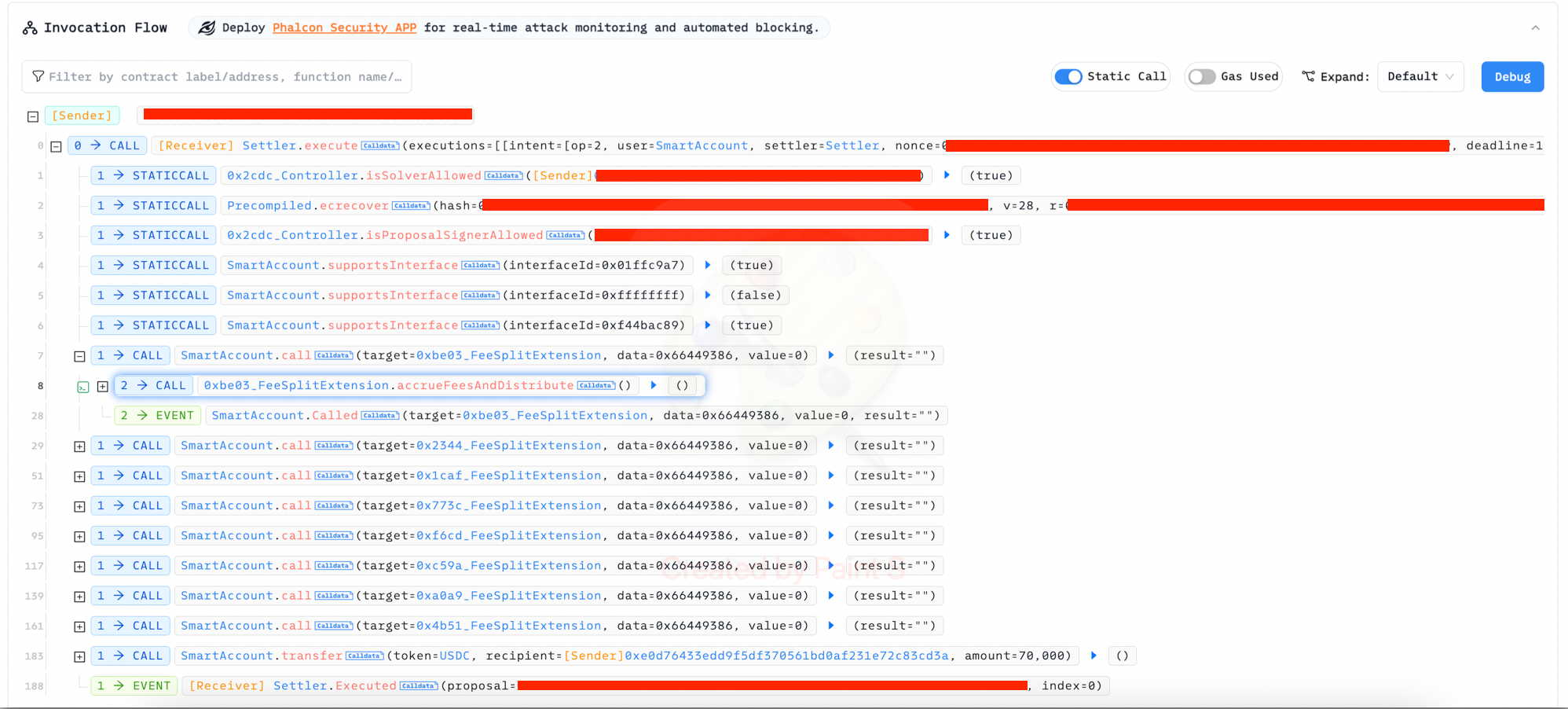
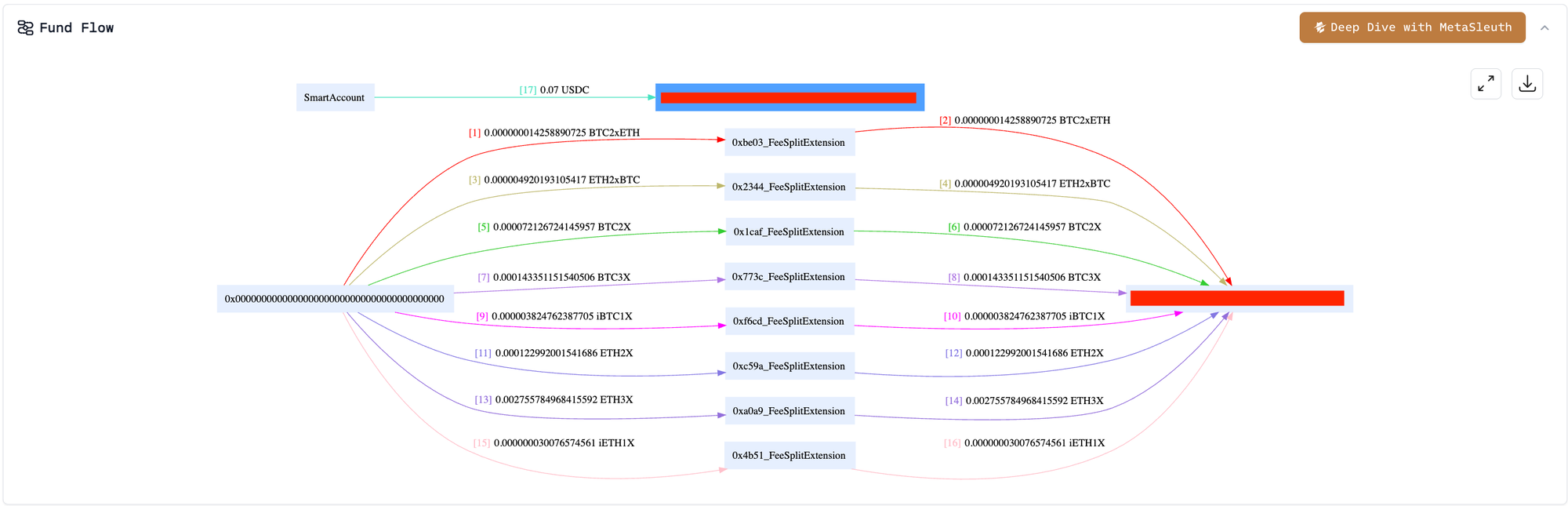
Each "FeeSlitExtension" contract obtains the fees for each token (BTC2x, BTC3x, ETH2x, etc etc) and sends them to the depositor contract of Indexcoop’s environment. Also we can see a nice graph of all the different tokens being transferred:
## What We Gained and Why it Matters
We were about to write more code. Instead, we used our automation protocol, saving time, resources, and gaining security, plus a lot other benefits:
- No manual steps to forget
- No need to over-engineer a simple task
- We realized even our internal operations can use the same tools we are offering users!
In hindsight, this was an ideal Mimic Protocol use case, and we are very happy with the results. It is live on Arbitrum and Base, which means even if our automation protocol is in alpha version, it’s viable and genuinely useful for improving internal operations.
## The Lesson
While this is a basic use-case, it's good to see the protocol working, and already making our lives easier. Mimic Protocol is able to do so much more, but this also shows the flexilibity of the system: it can cover from very simple and specific actions (like calling multiple contracts at the same time) to more complex needs around treasury management or portfolio rebalancing.
The next time you're about to solve a repetitive blockchain operation with a script, ask yourself:
> Would my life improve if I automate this?
If the answer is yes, think about using Mimic Protocol!
## Join the Mimic Protocol Alpha
As onchain automation continues to transform the way teams operate, Mimic Protocol is building a new standard in programmable, decentralized execution for Web3.
Alpha testing will start soon! If you're a crypto developer or protocol operator, now’s your chance to get ahead of the curve.
### Get alpha access to Mimic Protocol by clicking below 👇

Start simplifying how you code, execute, and scale blockchain projects. **Let automation handle the busy work while you focus on building.**
🐦 [X (Twitter)](https://x.com/mimicfi) | 📚 [Documentation](https://docs.mimic.fi/) | 📄 [Whitepaper](https://www.mimic.fi/documents/Mimic_Protocol_Whitepaper.pdf) | 💬 [Discord](https://discord.com/invite/qr2ywWuhxe) | 🌐 [Website](https://www.mimic.fi/) | 🌀 [Farcaster](https://farcaster.xyz/mimicfi) | 💼 [LinkedIn](https://www.linkedin.com/company/mimic-finance)
---
# Mimic EthCC[8] Wrap-up: Our Time in Cannes 2025
> From presenting trustless automation on the main venue, to launching our first public event, here's a recap of Mimic at EthCC[8] in Cannes!
Published: 2025-07-11 | Updated: 2025-07-11 | Author: Mimic Engineering Team | Tags: Events | Source: https://www.mimic.fi/blog/mimic-ethcc-8-wrap-up-our-time-in-cannes-2025

EthCC 2025 was a huge success! This year it was hosted in Cannes, in the south of France, and despite some early criticisms, the event turned out to be great, with more people focusing on building and creating rather than subtracting from the ecosystem.
The Mimic team attended both the main conference, as well as some super high quality side events (where we got the most alpha). We want to share our experience, what we learned, and the key takeaways for Mimic and our new automation protocol.
Whether you attended EthCC or not, let’s explore what happened during the week in Cannes!
## Sentiment Turned Bullish Quickly
When Cannes was announced for EthCC\[8\], there was a bit of backlash at the beginning, about the city being small and expensive, hot weather, and the closest airport being Nice (not an international hub).
But as soon as people saw the main venue, and how good the city was for hosting side events, sentiment changed to positive fast.
## Main Venue
The main event of EthCC\[8\] was hosted at Palais des Festivais, the same venue that hosts the annual Cannes Film Festival, the Cannes Lions International Festival of Creativity, MIPIM, and the NRJ Music Awards.

It’s a great convention centre, with bigger and smaller stages, and an outdoor space where the food court was located. The ac worked great, and there were so many interesting panels and workshops, although sometimes the organization could have been a bit better.
Overall it was a great space to host a crypto conference: it was big enough so you wouldn’t feel crowded but small enough that random interactions could happen. Each floor was nicely colored, and there was a coffee station at the entrance that was very popular.
## Mimic Presentations at Palais des Festivais
We had two representations at the main venue: our CTO, Facu, and our tech lead, Agustín.
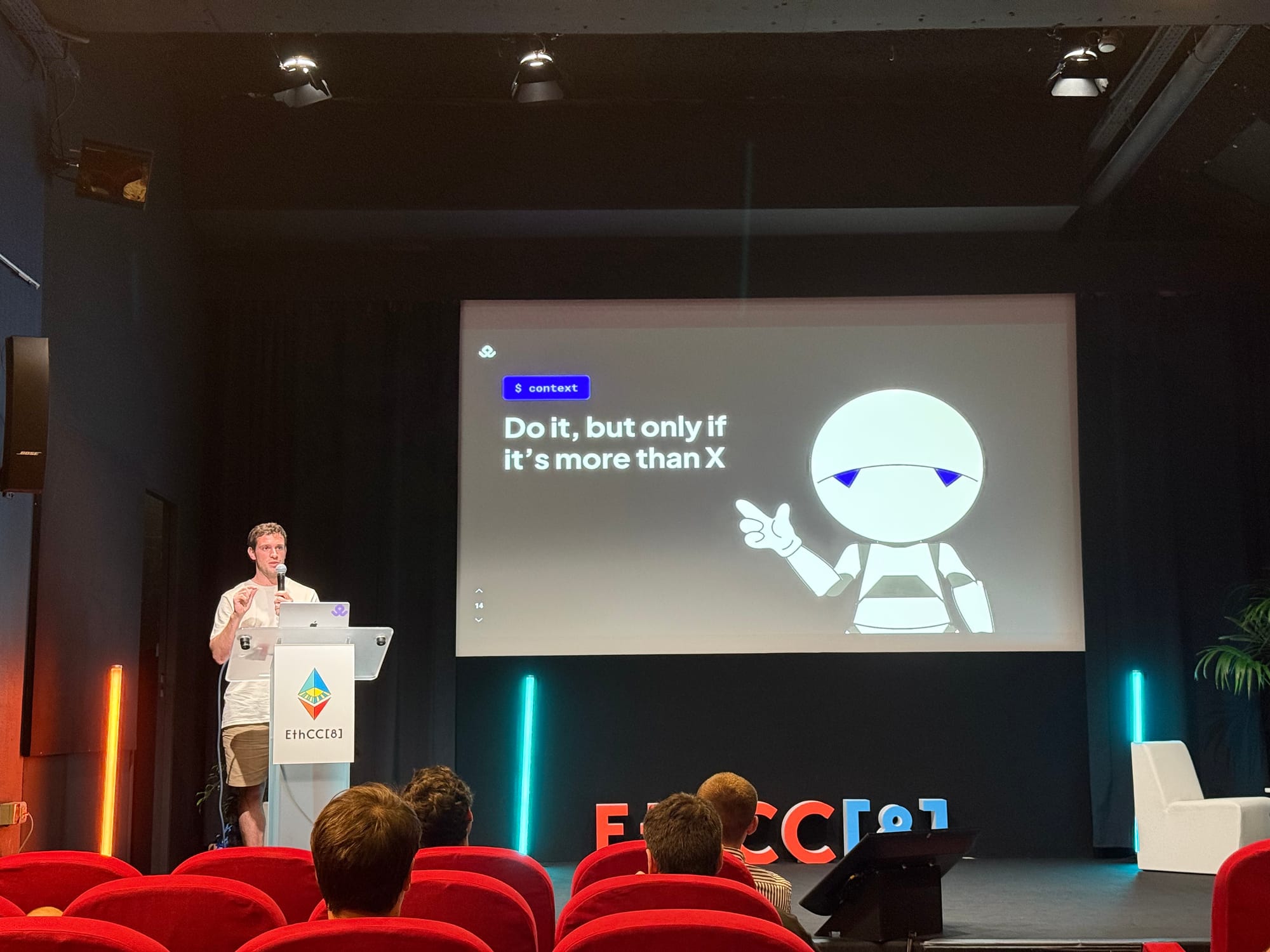
Facu Spagnuolo, Mimic's CTO and Co-Founder, introduced Mimic Protocol to a very engaged audience. He paid tribute to The Hitchhiker's Guide to the Galaxy, and used Marvin the Paranoid Android (a character in the books) to show how our automation protocol works.
We were very happy about the attendance, people seemed very interested about onchain automation, and asked some great questions, such as exploring potential onchain + offchain events in the future.
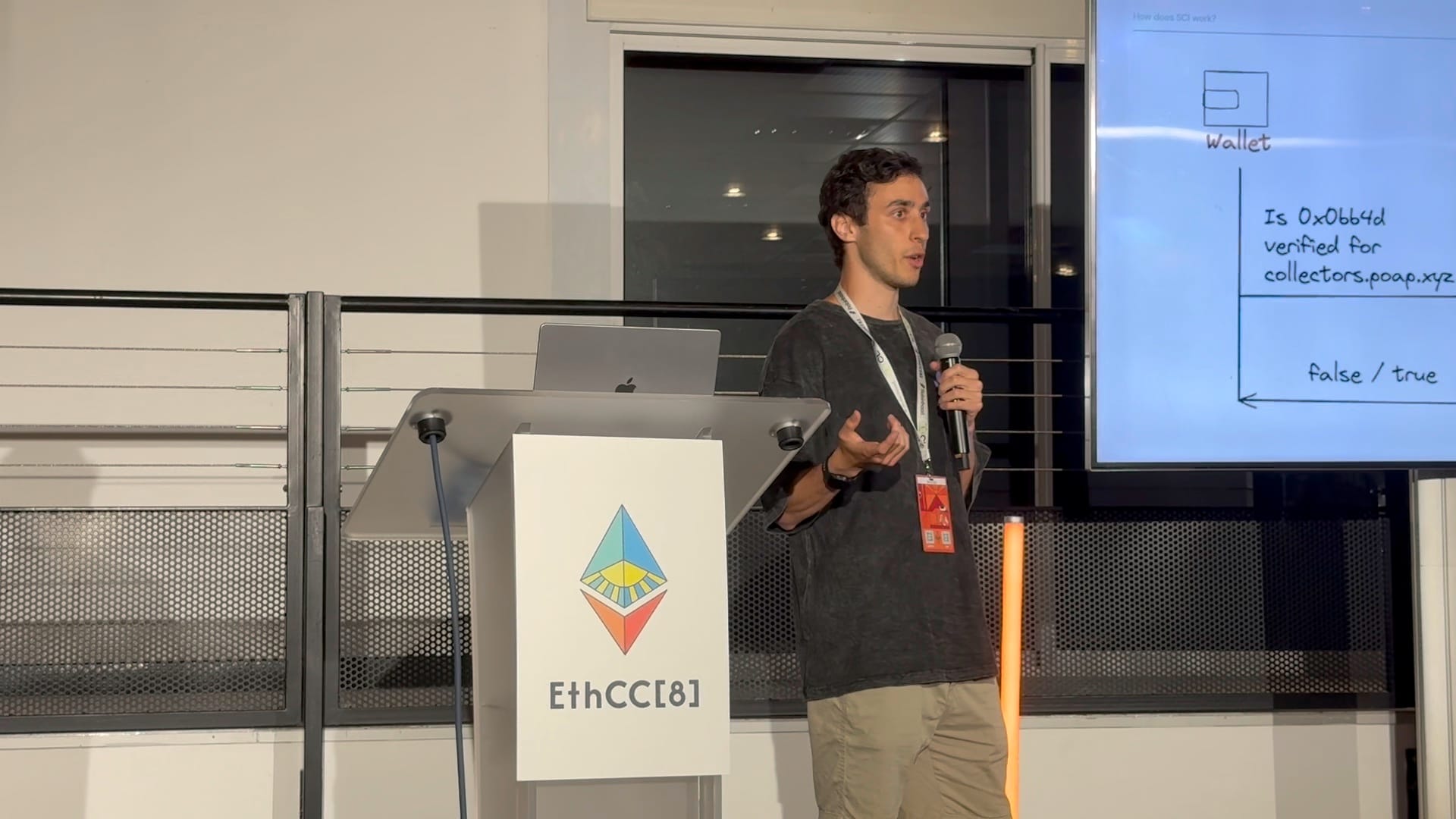
Agustín, Tech Lead, gave a presentation about enhancing web3 Security through smart contract verification, and showed how his open-source verification system worked. You can watch the [full video here.](https://ethcc.io/archives/sci-enhancing-web3-security-through-smart-contract-verification)
## Below the Surface: Our Side Event at EthCC
We hosted our first ever public event on July 3rd 2025. We were very excited, but uncertain on how it would turn out, but we were very surprised to see so many great people joining us to talk about **onchain automation** and infrastructure.
We introduced the Mimic Protocol for the first time in a public demo. Here is a bit more context about it:
* * *
### 🛠️ Introducing Mimic Protocol
[Mimic](https://x.com/mimicfi) is building an automation protocol for onchain builders.
We have been providing blockchain automation solutions since 2021 for top leaders in the industry, such as 1inch, Balancer, Ledger, Trezor, Trust Wallet, or WalletConnect, among others.
After 4 years of building infrastructure, we realized that a lot of users have needs for blockchain automation, but there are no clear standards in Web3.
With Mimic Protocol you can automate everything onchain:
- Create or select the onchain tasks to automate (like swaps, transfers, staking)
- Set your triggers (onchain events, cron schedules, balance thresholds, and more)
- Let the protocol take care of the execution
Potential users include devs, protocols, AI agents, DAOs, and financial institutions.
* * *
The biggest win is that people were truly interested in onchain automation and saw the potential of bringing a new standard into Web3. We are very happy with our first event, and will look forward to improving the experience for Devconnect Argentina!
Overall it was a great experience, and we learned a lot. We are more inspired than ever to build, and we are sure onchain automation can help crypto grow, and scale blockchain operations and workflows to the next level.
## Become a Mimic Protocol Alpha Tester!
If you want to try our automation protocol before it becomes publicly available, simply ****fill out this form:****
[Form here](https://forms.fillout.com/t/bsQfgbMcLPus)
## Our Side Events Experience at EthCC\[8\]
While the main venue is great, full of amazing experiences, the best interactions we had were attending all kinds of side events.
Some of our favorites were DeFi Summer, Builder Nights by Metamask, all 1inch events, rAave, the different sports events, and WalletConnect brunch, among others!

## Learnings From EthCC\[8\] in Cannes
Never stop building: the blockchain space is maturing, and people are becoming more interested in real numbers and revenue-generating projects. The time to build is now.
The vibes are changing. Less talk about memecoins, and speculation, more talk about the real impact of blockchain in the world, and potential use cases of the technology on everyday’s lives.
**Crypto needs onchain automation in order to scale.** Every other industry grew with some sort of automation: agriculture, banking, software. Now it’s time for blockchain automation to grow to the next level. We’re ready to put our builder hats on and to work on solving these problems!
See you next year in Cannes EthCC\[9\]!

---
# Mimic at EthCC 2025: Bringing Onchain Automation to Cannes
> Join Mimic at EthCC 2025 in Cannes, and explore the possibilities of onchain automation in a beautiful location!
Published: 2025-06-29 | Updated: 2026-02-02 | Author: Mimic Engineering Team | Tags: Events | Source: https://www.mimic.fi/blog/mimic-at-ethcc-2025-bringing-onchain-automation-to-cannes-2
The Mimic team is at Cannes for EthCC 2025! We want to put onchain automation on the map, so we are coming to EthCC this year with a bag full of surprises. Expect cool merch and gifts, great conversations, and our own event: Below the Surface.
We’re opening up blockchain automation for the community with Mimic Protocol, a decentralized automation layer for onchain builders. We’ve been working very hard for the past few years to give Web3 some necessary standards to scale blockchain operations and projects, so we are extremely excited to reveal our progress in public!
EthCC is where it all begins, so let’s explore what we are planning to do, and why it matters. Keep reading to find out how it all started, and what’s coming for Mimic Protocol.
If you are a builder at heart, and onchain automation sounds interesting, join our event on July 3rd here:

### The Journey of Mimic
Mimic has been providing blockchain automation solutions since 2021 for top leaders in the space, like 1inch, Balancer, Ledger, Trezor, Trust Wallet, or WalletConnect, among others. To date, we’ve helped them improve their day-to-day task management and significantly reduce the effort required to perform frequent transactions such as collecting, swapping, or bridging assets.
After 4 years of building infrastructure for top players in the space, we had all the pieces to open up the experience to the community, and create a fully decentralized automation protocol.
If you want to explore Mimic’s journey and see everything we have learned so far, we published a blog detailing all of it: [check it out here!](https://www.mimic.fi/blog/the-mimic-automation-story-early-days-to-protocol-design)
### What is Mimic Protocol?
[Mimic Protocol](https://www.mimic.fi/) provides blockchain automation for Web3 builders. Users and devs can create or select the [functions](https://docs.mimic.fi/resources/glossary#function) they want to automate, set their logic, and the protocol handles the rest: execution, security, and reliability.
It’s a decentralized solution to automate any blockchain operations (like swaps, transfers, staking) with different triggers, such as onchain events (even across chains), chronological schedules (times & dates), and other types of custom conditions (like balance thresholds). Users can implement pre-built automation, or code their own custom tasks directly in their apps or backend, offering them flexibility to build and scale exactly what they need.
If you want to learn more, check out our [whitepaper & documentation!](https://www.mimic.fi/whitepaper-and-docs)
### Why Develop an Automation Protocol?
A lot of developers and builders have needs for blockchain automation, but there are no robust solutions in the space, and the community needs Web3 standards. We want to set a new standard for [onchain automation](https://www.mimic.fi/blog/what-is-onchain-automation), creating a great developer experience, growing adoption, and achieving full decentralization, while helping builders integrate automation directly into their apps or backends with minimal effort.
Mimic Protocol is a blockchain automation protocol designed to streamline and secure onchain operations. Web2 already has standards for automation, [we want to bring the same level of scalability to Web3.](https://www.mimic.fi/blog/can-web2-automation-work-in-web3)
### Mimic at EthCC
**Below the Surface Event: Onchain Automation**
Below the Surface is a space to celebrate and empower the builders shaping the future of blockchain, exploring all the possibilities of automation in Web3.
A hands-on gathering for developers, protocol teams, and infra providers to experiment and explore how to scale onchain infrastructure. This is not your average side event: live demos, collaborative workshops, love for blockchain, and conversations that matter.
We will explore some interesting usecases:
- Fee collector
- Treasury management (or DeFi strategies)
- Recurrent payments/ billing
- Airdropper solution
- Portfolio rebalancer
- Account topper
- Yield aggregator
📍 July 3 | 🕒 3–7 PM CEST
Register here:

**Mimic Protocol Live Demo**
We will be presenting the first public demo of Mimic Protocol, the automation layer for onchain builders. We’ve spent the last four years building automation infra under the hood, now it’s time to open it up to the community, and we want you to try it out.
Our technical team will show some cool automation usecases, will be coding tasks live, and will also help the people that want to test out our automation capabilities.
For people attending and participating in the event, we will be giving out some cool gifts, and you will have priority as alpha tester before we launch Mimic Protocol to the public!
**Attending Side-events**
The Mimic team will also be fully immersed into EthCC!

If you want to meet up or discuss onchain automation before the event, reach out:
[Twitter](https://x.com/mimicfi) | [Discord](https://discord.com/invite/qr2ywWuhxe)
### Join us Below the Surface at EthCC!
Our event capacity is limited. Reserve your spot early!
Let’s explore the future of onchain infra, and have a drink while we’re at it!

---
# The Mimic Automation Story: Early Days to Protocol Design
> This is Mimic’s journey, a story about turning a whiteboard idea into the automation standard for Web3, and why it matters.
Published: 2025-06-26 | Updated: 2026-02-02 | Author: Mimic Engineering Team | Tags: Mimic Platform | Source: https://www.mimic.fi/blog/the-mimic-automation-story-early-days-to-protocol-design
On June 10th, 2021, three founders sketched out a bold idea on a whiteboard. Four years and $7b in processed value later, our automation has evolved into a flexible protocol that empowers builders to automate a wide variety of blockchain operations.
> This is Mimic’s journey, a story about how we turned a whiteboard idea into the automation standard for Web3, why it matters, and what got us here.
It’s been a path marked by both trial and error and crucial insights. Each version of Mimic taught us new lessons about decentralization, scalability, user experience, and how best to integrate into the broader blockchain ecosystem. This is our quest towards onchain automation.
## Why This Story Matters
This blog post is for anyone curious about Mimic’s origin, evolution, and the hard-earned lessons behind our Protocol. It’s the founder’s-eye view of the product design journey, from MVP hacks to a robust infrastructure serving billions in automated volume. If you're building in Web3 or exploring programmable automation, this one’s for you.
## The Early Days of V1: Structured Strategies in Smart Contracts
In the beginning of 2021, Mimic was built around on-chain strategies that were essentially “recipes” for DeFi operations, each one tightly embedded in its own smart contract. It worked well for specific use cases—like a certain lending-borrowing pattern—because everything was predefined: users only had to plug in a few parameters. But that same rigidity was also its weakness. If you wanted to change a step or tweak a condition, you often needed an entirely new contract deployment. Worse, there was no real scheduling or relayer network; users still had to press the “Execute” button at the right time.
This approach proved that onchain automation could handle repetitive DeFi actions, yet it fell short of being truly automated or flexible. We realized that allowing more dynamic configuration, letting users adapt strategies on the fly, would be critical for scaling.
## Enter v2: Extracting Configurations & Empowering Users
With that lesson in mind, we took a big leap in 2022 with Mimic v2, by breaking out important parameters and configurations from the smart contracts themselves. Instead of a hard-coded sequence of DeFi steps, users could now define elements like token addresses, thresholds, or triggers at runtime, without redeploying everything. We also introduced the concept of relayers to start automating tasks under simple conditions, though we were still figuring out how best to integrate external data sources like price oracles.
This shift taught us a few things. Granting more control is powerful but can easily become inconvenient if every detail has to be set up from scratch. We also learned that robust validation of external data—think “swap only if the price is below X”—would be essential for safe, dynamic triggers. And perhaps most importantly, we saw the real promise of a network of relayers who could take care of executing tasks entirely, removing the need for users to intervene at critical moments.
Ultimately, v2 was a major step toward letting users shape strategies to their needs, but we still lacked a truly modular system for tasks. We also realized we’d need “connectors”—adapters for specific DeFi protocols—to handle the growing complexity of integrations.
## v3 (Present Day): Modular Tasks, Connectors & Relayers
Mimic v3 takes the best of those earlier lessons to create a truly **modular** and **decentralized** automation platform.
### Building Blocks: The Rise of Standardized Tasks
We introduced a library of common DeFi operations (swapping, bridging, lending, borrowing, rebalancing, etc.). Users choose from these tasks like building blocks. Each task is highly configurable, so you can set parameters, triggers, and conditions.
### Connectors: The Key for Protocol Integrations
Instead of hardcoding everything, we use “connectors” as plug-and-play modules to interface with external protocols (like Uniswap, Aave, 1inch, Paraswap, Hop, LiFi, etc). This means tasks remain _extensible_: if a new protocol emerges, we can develop a connector and slot it right in.
### Relayers & Delegation: Automation Without Sacrificing Control
Users can finally delegate the execution of tasks to Mimic relayers, who handle the heavy lifting of sending transactions, monitoring chain states, and verifying oracle data. This architecture also opens up the door for multiple **independent** relayers (think of them as decentralized operators) who compete or cooperate to ensure tasks get done reliably.
### Onchain Security & User Control
All automation logic is enforced on-chain via **smart contracts** that check user-defined conditions. There’s no custodial risk: Mimic never holds your private keys or takes custody of your assets. Everything is validated by the protocol’s smart contracts.
This structure—customizable tasks, modular connectors, and relayer delegation—gives users an **AWS-like** automation experience, but in a trustless and decentralized environment.
## Building the Protocol: Turning Learnings into Architecture
While experimenting with onchain strategies, user-defined configurations, and the initial relayer concepts, we discovered we already had the essential pieces of a truly trustless system, and in 2024 we decided to start building Mimic Protocol, with components such as oracles, relayers, and user safeguards.
But putting them together into a coherent, scalable framework required a new architectural approach. If we wanted Mimic to evolve into a fully decentralized protocol, opening the door to automated and trustless operations across multiple chains, we needed a tech stack that made sense, was elegant, and did not rely on partial solutions or centralized steps.
After key iterations, we designed a system that boiled down to **three core layers**:
### Planning Layer
This is where **functions** are defined, combining oracle inputs, user-defined logic, and triggers. It’s also where relayers first come into play, fetching data and determining whether conditions are met.
### Execution Layer
Once a function is ready to run, it transforms into an **intent** and heads to a decentralized environment where solvers compete to execute it. By letting multiple parties submit proposals, we ensure the best fee/latency combination and avoid single points of failure.
### Security Layer
Finally, a **settler contract** verifies that the solver’s execution meets the original safeguards—things like deadlines, slippage limits, or maximum spending caps. Only then does it finalize the transaction onchain, ensuring funds stay secure and under the user’s control.
Together, these three layers offer a **fully automated** pipeline: from reading real-time data to actually executing and verifying each action on-chain. By adding in economic incentives and staking mechanisms for oracles, relayers, and solvers, we’re buiding a protocol that prioritizes **reliability**, **transparency**, and **user-defined security**—all the lessons we gained from our early explorations in our past versions.
If you are interested in a more technical explanation, here is our [whitepaper](https://www.mimic.fi/documents/Mimic_Protocol_Whitepaper.pdf) (opens a pdf link).
## What We Learned Along the Way
- **Modularity Unlocks Scale:** Splitting operations into tasks and connectors avoids the “one strategy = one contract” problem. Users love building custom workflows from standardized building blocks.
- **User-Centric Configuration:** Letting users tweak parameters in real time was a game-changer. It lowered the barrier to entry and gave non-technical participants more control.
- **Incentivized Decentralization:** For relayers to be truly decentralized, we needed a staking and slashing mechanism, plus robust oracle/data validation. It took real-world testing to refine these incentives.
- **Keep the UX as Simple as Possible:** Automation can be complex under the hood, but it shouldn’t feel that way to the user.
## What’s Next?
We’re aiming to create a system where tasks are transparently defined, executed, and settled on-chain, all while giving users granular control over what happens and when.
In short, our ambition is to provide an **open, modular protocol** that anyone can build on, removing the last barriers to full automation for blockchain. By democratizing the tools for scheduling, triggering, and executing onchain tasks, we’re one step closer to a future where users and developers can orchestrate complex operations with ease, all while trusting the integrity of each step.
## Conclusion
Mimic’s evolution hasn’t always been a straight line, but it revealed invaluable lessons at every turn. Each iteration revealed what real-world users truly need: flexibility, transparency, and genuine hands-off automation. Today, we’re turning those lessons into a **decentralized automation protocol**. Yet this is only the beginning. As we complete our decentralized architecture and expand our integration capabilities, Mimic will become even more powerful and user-friendly.
## Join the Mimic Protocol Alpha
As onchain automation continues to transform the way DeFi teams operate, Mimic Protocol is building a new standard in programmable, decentralized execution for Web3.
Alpha testing will start soon! If you're a crypto developer or protocol operator, now’s your chance to get ahead of the curve.
### Get alpha access to Mimic Protocol by clicking below 👇

Start simplifying how you code, execute, and scale blockchain projects. **Let automation handle the busy work while you focus on building.**
🐦 [X (Twitter)](https://x.com/mimicfi) | 📚 [Documentation](https://docs.mimic.fi/) | 📄 [Whitepaper](https://www.mimic.fi/documents/Mimic_Protocol_Whitepaper.pdf) | 💬 [Discord](https://discord.com/invite/qr2ywWuhxe) | 🌐 [Website](https://www.mimic.fi/) | 🌀 [Farcaster](https://farcaster.xyz/mimicfi) | 💼 [LinkedIn](https://www.linkedin.com/company/mimic-finance)
---
# Mimic Fee Collector: Automate Your Onchain Fee Management
> Automate your onchain fee management with Mimic Fee Collector. Consolidate all your fees into a single asset with secure, crosschain automation.
Published: 2025-06-13 | Updated: 2025-06-29 | Author: Mimic Engineering Team | Tags: Fee Collector | Source: https://www.mimic.fi/blog/mimic-fee-collector-automate-your-onchain-fee-management
What happens if you are a Web3 company or protocol generating revenue fees in different tokens, across multiple chains, from thousands of accounts? Fee management becomes incredibly hard.
Manual collection, swapping, bridging, and distributing the fees is time-consuming, error-prone, and expensive. It often costs teams hundreds of hours and exposes them to risks from human error and volatile gas fees.
To manage revenue fees, many teams build custom scripts or internal tools. While this solves some of the challenges, it introduces new problems, such as relying on private data sources, server-stored keys, and manual intervention through regular maintenance, updating, and testing.
Some projects use centralized solutions, giving them whole ownership of the tokens and full access through the whole process. While this seems practical, it is definitely not DeFi-friendly, and the projects lose control of the funds, adding an extra layer of risk.
Even with skilled devs, internal automation drains valuable time and requires updates with every protocol change. You can’t just “set and forget” fee workflows.
Guess what…? **There’s a better way:** Mimic solution automates onchain fee collection across networks, securely, efficiently, and without sacrificing control.
## Introducing Mimic Fee Collector
A fully automated, secure, and customizable solution trusted by industry leaders like 1inch, Balancer, Ledger, Trezor, Trust Wallet, or Velora, among others.
Projects and protocols can consolidate all their fees into a single asset with crosschain automation. This results in **improved cost efficiency, reduced error risk**, and, most importantly, the **freedom to focus** on strategic decision-making rather than day-to-day operations.
It is an end-to-end solution that collects, swaps, bridges, and withdraws to the designated address(es). You can define your own parameters like frequency, thresholds, and limits to fit your operations cycle.
Mimic Fee Collector includes real-time reporting features that provide structured, actionable data for each step of the process, enabling teams to make informed decisions efficiently. The reporting has been audited by EY, ensuring institutional-grade security and reliability.
The system is constantly checking when the client conditions are met, while being cautious of gas spikes (gas-efficiency), and controlling price against oracles to get a good price. Live across most EVM networks, with full security, customization, and easy integration in mind, all while running 24/7 to execute the conditions whenever possible.
For example, many projects decide to convert all their collected fees into a stable coin like USDC on a single network, for efficiency, cost savings, and also accounting benefits.
## How Does it Work?
Mimic deploys a dedicated environment for each client, ensuring operational efficiency while keeping the system trust-minimized and reliable.
At the core of this architectural framework, the environment enables autonomous operations without interference. This means that users' tasks and components operate autonomously, without colluding or interfering with one another. Our deployment process ensures that different instances running on different chains can seamlessly interact with each other, eliminating the need for users to worry about crosschain interoperability.
There are five main tasks performed automatically in Mimic’s fee collection model:
- **Collect** from whitelisted wallets/contracts from multiple sources across networks into a smart vault.
- **Swap** at best prices, using top DEX aggregators with set slippage, thresholds, and gas costs (ie: we do not swap if the cost is above some % of the value being swapped).
- **Bridge** across networks using protocols like Socket or Circle’s CCTP Bridge.
- **Withdraw** to any recipient address specified (e.g., DAO multisig or community wallet).
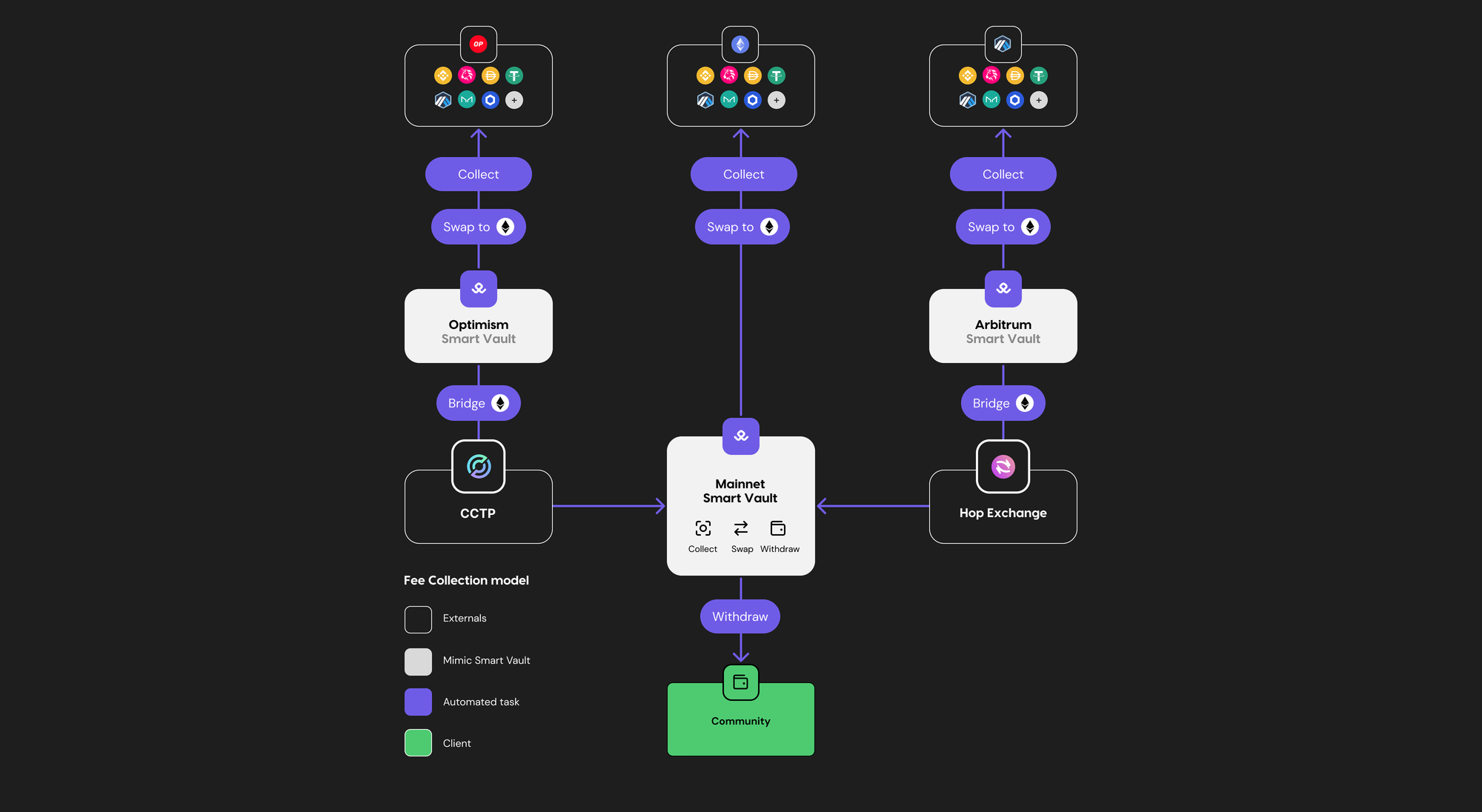
Another key component of the system is the **Splitter:** divides/splits assets according to user-defined percentages. Can be placed at different points in the flow.
Some clients use it at the beginning, others during the swap part and others right before the withdrawal, highlighting the flexibility of this solution, adapting to many different operational needs and on-chain workflows.
Want to to learn more how you can integrate it? [https://www.mimic.fi/fee-collector](https://www.mimic.fi/fee-collector)
## Built for Wallets, DAOs, DEXes, and Beyond
Mimic Fee Collector helps projects automate on-chain revenue workflows. Instead of manually checking balances, swapping tokens, and bridging funds crosschain, Mimic handles it all behind the scenes, based on your rules.
For example, Velora (fka ParaSwap) used to spend hours every month managing protocol fees across seven chains. With Mimic, they now automatically collect and convert fees to wETH, and have custom distribution within the DAO every epoch. No manual work, no missed steps.
DEXes and aggregators use Mimic to make sure fees earned on one chain get swapped and bridged to a preferred chain in the right token, at the right time. Our smart simulations help pick the best moment to execute, saving costs on gas and slippage.
Wallet providers and custodial tools benefit from Mimic’s non-custodial setup. No more hot wallet risks, just secure automation with full control. And because everything is tracked and reported, it’s easier to share updates with your community or auditors. We provide a detailed report at the end of each epoch.
Whether you're running a DAO treasury or managing protocol incentives, Mimic Fee Collector saves you time, cuts costs, and helps you focus on what matters—building.
## Fee Management With Full Customization
Within Mimic’s Fee Collector, users have the freedom to choose the destination chain where they wish to receive their consolidated fees. They can also customize the conditions for any executing bridge tasks based on individual preferences. For instance, users can opt to trigger the tasks once a specific threshold amount is reached on each chain, or they can schedule regular periodic executions.
Additionally, users can pick both the DEX swap and the bridge protocols they trust (from the ones we support), enabling them to bridge assets across protocols that align with their preferences and requirements.
Mimic's solution can be customized to meet each user's requirements by configuring:
1. Roles and permissions of the parties involved
2. Whitelisted DEXes and aggregators to execute swaps
3. Threshold balance for triggering operations
4. Maximum allowed slippage for swaps
5. Destination chains to bridge assets
6. Recipient address to send swapped fees back
7. Destination token to swap all the fees
8. Gas price limits per operation
9. Maximum transaction cost percentage (instead of gas price)
## Secure by Design
Mimic's solution is secure due to its trustless design, smart contract auditing, and robust permission models. Mimic is completely decentralized and non-custodial. Our built-in authentication and permissions system ensures that only authorized accounts can execute specific operations. Our Smart Contracts have been audited by Certora, Verlog, and independent auditors from Open Zeppelin.
## End-to-end Solution & Dedicated Support Every Step of the Way
We work hard to provide a seamless integration experience, working alongside your protocol to ensure the implementation is easy, fast, and as pain-free as possible.
Since we have extensive experience working with Web3 protocols across multiple networks, we have developed a list of best practices that we follow to help you get the most out of your fee management structure!
### How Long Does it Take to Get it up and Running?
After settling the final configuration details, the Mimic team will be fully responsible for setting up the required environment. The entire process should not take longer than a few weeks.
### List of Supported Networks and Aggregators
Active across Ethereum, BNB Chain, Polygon, Optimism, Arbitrum, Gnosis, Avalanche, Fantom, Aurora, Base, zkEVM, Mode, Blast, and Sonic. Coming soon to Solana!
[\[Link to supported Networks\]](https://www.notion.so/Supported-networks-24ef0204dbef4cbeb119273be01092b2?pvs=21)
Works with leading DEX/bridge aggregators:
- DEXes: 1inch, Velora (formerly ParaSwap), Kyberswap, Odos, Bebop, among others.
- Bridges: CCTP/Wormhole, Socket, Axelar, Symbiosis, among others.
## Want to Build Your Own Fee Management Tool?
With our upcoming Mimic Protocol you will be able to create your own fee collection solution: [https://docs.mimic.fi/use-cases-and-examples/more-examples/fee-collection](https://docs.mimic.fi/use-cases-and-examples/more-examples/fee-collection)
Mimic Protocol is a modular automation protocol that simplifies developing and scaling blockchain projects for Web3 builders. You can develop your own fee management tool with full control over onchain operations, automation logic, and execution.
You will be able to create your own operations (collect, swap, bridge, withdraw), and set the conditions you want, giving you the flexibility to build your own fee management solution.
Want to learn more? Visit [https://www.mimic.fi/](https://www.mimic.fi/) or read our [whitepaper/docs!](https://www.mimic.fi/whitepaper-and-docs)
## Wondering if Mimic Fee Collector Fits your Flow? Let’s Chat
Whether you're managing a DAO, running a DEX, or just tired of juggling tokens across chains, we’ll help you automate it safely and on your terms.
Mimic's ability to streamline fee collection across multiple chains empowers projects to focus on their core activities while effortlessly consolidating their earnings.
This not only simplifies financial operations but also enhances transparency and efficiency in managing protocol revenues.
Le'ts talk! [https://www.mimic.fi/contact](https://www.mimic.fi/contact)
* * *
🐦 [X (Twitter)](https://x.com/mimicfi) | 📚 [Documentation](https://docs.mimic.fi/?utm_source=ghost&utm_medium=blog&utm_campaign=mimic_docs) | 📄 [Whitepaper](https://www.mimic.fi/documents/Mimic_Protocol_Whitepaper.pdf) | 💬 [Discord](https://discord.com/invite/qr2ywWuhxe) | 🌐 [Website](https://www.mimic.fi/) | 🌀 [Farcaster](https://farcaster.xyz/mimicfi) | 💼 [LinkedIn](https://www.linkedin.com/company/mimic-finance) | 🔁 [Fee Collector](https://www.mimic.fi/fee-collector)
---
# Can Web2 Automation Work in Web3?
> Web3 still lacks what Web2 takes for granted: automation. This blog explores how automation should work in crypto, and how Mimic Protocol can make it possible.
Published: 2025-06-09 | Updated: 2026-02-02 | Author: Mimic Engineering Team | Tags: Onchain Automation | Source: https://www.mimic.fi/blog/can-web2-automation-work-in-web3
Automation is everywhere: from individuals setting up calendar reminders to massive enterprises integrating, testing, and deploying software changes, **automation powers our digital word**. In Web2, it’s second nature. Tools like Zapier, Slack integrations, Google Scripts, CRMs, accounting platforms, and email marketing suites all come with built-in automation.
Need to send an invoice every 30 days? Want to notify your sales team when a lead reaches a certain score? Auto-deploy new code to production when your tests pass? All of that can be automated in a simple way.
Most operations in traditional finance are also automated:
- 60-75% of all the trading volume in U.S. equity markets is done through algorithmic trading | [Source](https://www.quantifiedstrategies.com/what-percentage-of-trading-is-algorithmic).
- 98% of all CFOs surveyed by McKinsey are investing in finance automation | [Source](https://www.mckinsey.com/capabilities/strategy-and-corporate-finance/our-insights/toward-the-long-term-cfo-perspectives-on-the-future-of-finance#).
- The network used for electronically moving money between bank accounts across the U.S. processed Over $42 trillion in value in 2024 | [Source](https://www.federalreserve.gov/paymentsystems/fedach_quarterlycomm.htm).
And it’s not just convenience, it’s _critical_. Automation reduces error, saves time, and allows people and teams to scale their operations without constant manual inputs. Whether it’s finance, logistics, software, or customer engagement, automation is how modern systems run.
## But What Happens When You Step into Web3?
Suddenly, all the things we take for granted become difficult. The large number of chains, the cost of execution, and the trustless environment mean that doing something as simple as "send tokens every Monday" is **a whole infrastructure and security challenge**.
So we want to ask in this blog: what would it take for automation to work in Web3? Could those same Web2 automations work in a decentralized space?
It’s clear that not everything will translate the exact same way, because there are major structural differences between traditional tech stacks and blockchain, but the use cases can be adapted.
Let’s explore some Web2 use cases and their potential counterparts in Web3!
## Case Studies in Automation: From Web2 to Web3 With Mimic Protocol
### Scheduled Payrolls
#### Web2
Automating recurring salary payments and bonuses are streamlined in Web2. Services like Gusto, Deel, or ADP handle everything: they pull the funds from the company account, convert currencies if needed, apply tax rules, and distribute salaries or bonuses to teams, often across time zones or countries (although global payments are a different topic).
#### Web3
If you want to automate payrolls in Web3, you need to take into consideration the distribution of funds to multisigs, or predefined wallets. Imagine you’re a DAO or a DeFi protocol with contributors or stakeholders across chains. You’ve got revenue coming in on Arbitrum, treasury assets held on Ethereum, and payments due to contributors in USDC on Polygon, and maybe one core contributor only accepts wETH. There’s volatility in token prices, slippage on swaps, and bridge delays to consider.
#### Scheduled Payrolls With Mimic Protocol
Mimic Protocol enables you to encode your payroll logic once, and let automation handle the rest, with full visibility and control. Here’s what the flow could look like:
1. Collect Function: automatically collect earnings from deployed contracts or payroll wallet addresses.
2. Swap Function: if contributors are paid in stablecoins (USDC, DAI), the Protocol can convert volatile tokens (e.g., AAVE, BAL) into stable assets, or convert to their token of choice.
3. Bridge Function: bridge assets from the treasury vault (e.g., on Ethereum) to contributor destination chains (e.g., Polygon).
4. Withdraw Function: Once assets are in place, funds are automatically distributed to each contributor or multisig, following the rules you define (e.g., every 30 days).
This is just one way to build a scheduled payroll system. Since everything can be encoded onchain, you could set up this solution to adapt to your specific operations.
### Currency Conversions
#### Web2
Automated foreign exchange (FX) has become a standard feature in tools like Wise, Revolut, and even corporate finance systems. Want to convert EUR to USD every Friday at 9am, or auto-swap only if the rate drops below 1.05? It is possible.
Behind the scenes, these tools shield users from volatility by batching conversions, alerting them to unfavorable conditions, and avoiding execution during spikes in transaction fees or rate spread. All this creates a sense of reliability and predictability, even in the unpredictable world of currency markets.
#### Web3
In Web3, the same need exists, but it's significantly harder to fulfill. Protocols, DAOs, and yield strategies often earn fees or rewards in volatile governance tokens (like AAVE, BAL, UNI, or COMP). While these assets are useful within their ecosystems, they aren’t ideal for stable operations or payouts. Teams typically want to convert them into stablecoins like USDC or DAI, which serve as a more dependable base for:
- Contributor payments
- DAO treasury allocations
- Grant funding
- Revenue recognition
But unlike in Web2, there's no bank API here, just DEXs, gas fees, and slippage. And timing matters.
#### Token Conversions With Mimic Protocol
Mimic Protocol enables onchain rules-based token swaps that work just like FX automation, but built for the decentralized, multi-chain world. You can define logic such as: “If my AAVE balance exceeds $3,000, swap to USDC using a DEX aggregator, but only if slippage is under 0.5% and gas is below 100 gwei.” Or, schedule recurring swaps: “Convert UNI to DAI every Monday at noon.” You retain full control over parameters like timing, gas limits, slippage tolerance, and allowed aggregators, all enforced onchain.
With different types of triggers supported, like chronological (time & date), event based (onchain actions or oracle prices), or custom thresholds, you can create token conversion workflows for different use cases, depending on what you want to achieve.
### Portfolio Rebalancing
#### Web2
In traditional finance, investment platforms like Wealthfront, Betterment, or Schwab Intelligent Portfolios offer automated portfolio rebalancing. Users define a target allocation — say, 60% stocks, 30% bonds, 10% cash — and the system automatically adjusts their holdings when the actual mix drifts too far from the target due to market movements.
This kind of automation removes emotion from investing, maintains long-term strategy, and saves investors from tedious manual intervention. These services custody user assets and have centralized authority to move funds freely within the platform. Users trust the system to do what’s right, and the system handles all trades, taxes, and timing behind the scenes.
#### Web3
In Web3, portfolio rebalancing is just as important, especially for DAOs, treasuries, or yield strategies trying to maintain specific allocations between volatile and stable assets. But the environment is radically different:
- Assets are self-custodied in multisigs or Smart Contracts.
- Rebalancing means manual swaps, bridging, and tracking across multiple chains.
- Every action costs gas, introduces slippage, and requires precise timing.
Several centralized exchanges (CEXes) and related platforms do offer portfolio rebalancing options, though typically with varying levels of automation, control, and asset availability compared to traditional robo-advisors, not to mention relying on a fully centralized system.
#### Portfolio Rebalancing With Mimic Protocol
With Mimic Protocol, anyone can set up a fully automated portfolio rebalancing system tailored to their on-chain strategy. No spreadsheets, no manual swaps, no middlemen. Users define their ideal asset allocation and configure conditions for rebalancing, whether it's based on time (e.g., every Monday) or thresholds (e.g., when ETH exceeds 60% of the portfolio). Mimic Protocol makes it easy to enforce rules like slippage limits, gas price ceilings, and preferred DEX routes, ensuring swaps only execute under favorable conditions.
Building your own rebalancing system with Mimic makes sense because you control the keys, not a centralized exchange. You gain access to a wider range of assets beyond what CEXes support, can trigger actions based on real-time on-chain conditions, and operate across multiple networks, all without sacrificing transparency or self-custody.
You can read our guide about portfolio rebalancing here: [https://www.mimic.fi/blog/rebalance-a-wallet-portfolio-with-mimic-protocol-usd-targets-3-tokens](https://www.mimic.fi/blog/rebalance-a-wallet-portfolio-with-mimic-protocol-usd-targets-3-tokens)
### When This Happens, Do That Automation
#### Web2
Zapier, IFTTT, [Make.com](http://make.com/), n8n, and other platforms have made automation accessible to anyone. With a few clicks, users can set up workflows like:
- "When someone submits a form, send a Slack message."
- "Every Friday, export sales data from Shopify to Google Sheets."
- "If a tweet mentions our brand, create a support ticket."
These tools let businesses and creators connect services, respond to events, and automate operations, all without writing code. They abstract away the infrastructure and provide confidence that workflows just work reliably, quietly, in the background.
#### Web3
Web3 lacks a native automation layer. There’s no “connect your wallet and trigger this task if balance exceeds X” interface. Every action — swaps, bridges, wrapping, rebalances — needs to be executed manually, coded into custom smart contracts, or programmed through internal tooling.
Even basic workflows require manual steps, multisig coordination, and real-time market awareness. Add volatility, gas fees, and multi-chain fragmentation, and suddenly a "simple" automation becomes a full-time job.
#### Endless Possibilities With Mimic Protocol
Mimic Protocol simplifies that process, making onchain automation programmable, secure, and fully customizable. It allows anyone to build powerful workflows that react to real-time blockchain conditions, like swapping tokens when treasury balances grow, bridging assets during low gas periods, or sending scheduled payouts to contributors.
Every automation is fully defined by the user: what should happen, when it should happen, and under which conditions it’s allowed to execute. Whether you're managing a DAO, automating treasury operations, or building advanced DeFi infrastructure, Mimic gives you the tools to scale safely, with full decentralization & control, and across chains.
## About Mimic Protocol
At Mimic, we are building a crosschain automation protocol to simplify the way users build and scale blockchain projects. Mimic Protocol allows developers to define their rules, pick the tasks they want to automate, while the platform handles execution, offering full control over blockchain operations. Mimic enables teams to focus on innovation while the protocol ensures precision, efficiency, and trustless automation.
You can read the Mimic Protocol [whitepaper here](https://www.mimic.fi/documents/Mimic_Protocol_Whitepaper.pdf) (pdf will open up).
## Join the Mimic Protocol Waitlist
As onchain automation continues to transform the way crypto teams operate, Mimic Protocol is paving the way for a new standard in programmable, decentralized execution.
Beta testing is starting soon. If you're a crypto developer or protocol operator, now’s your chance to get ahead of the curve.
**Get early access to Mimic Protocol by clicking below 👇**

Start simplifying how you code, execute, and scale blockchain projects. **Let automation handle the busy work while you focus on building.**
🐦 [X (Twitter)](https://x.com/mimicfi) | 📚 [Documentation](https://docs.mimic.fi/?utm_source=ghost&utm_medium=blog&utm_campaign=mimic_docs) | 📄 [Whitepaper](https://www.mimic.fi/documents/Mimic_Protocol_Whitepaper.pdf) | 💬 [Discord](https://discord.com/invite/qr2ywWuhxe) | 🌐 [Website](https://www.mimic.fi/) | 🌀 [Farcaster](https://farcaster.xyz/mimicfi) | 💼 [LinkedIn](https://www.linkedin.com/company/mimic-finance)
---
# Challenges of Manual Transactions in Crypto
> Crypto promised full control, but it also brought a lot of manual transactions. Let's explore the challenges of manual txs and how onchain automation can help!
Published: 2025-05-29 | Updated: 2025-06-29 | Author: Mimic Engineering Team | Tags: Onchain Automation | Source: https://www.mimic.fi/blog/challenges-of-manual-transactions-in-crypto
Welcome to a new educational blog post where we explore the challenges of manual transactions for users and developers in crypto, and how onchain automation is the key for better user experience.
At Mimic, we are creating automation tools to simplify the way people code, execute, and scale blockchain projects. We want to share all our insights around exciting Web3 topics, and start setting the context of Mimic Protocol, our new decentralized automation layer, ahead of its public launch.
The early promise of crypto was ambitious: reduce reliance on traditional financial intermediaries and give users full control over their money.
Crypto has evolved a lot over the years, and the future is looking very promising. However, as anyone who’s handled manual crypto transactions knows, this promise of full control has come with a cost, notably in terms of user experience, both for developers and general public.
From Bitcoin’s early days to today’s complex and constantly changing space, manual transactions present a unique set of challenges, especially when it comes to crosschain ecosystems. Let’s break them down!
## Early Web3 Days and the UX Dilemma
When Bitcoin was created, sending a crypto transaction meant more than just entering an address and clicking “send”. It involved multiple steps, and a deeper understanding of transaction fees, confirmation times, and wallet management.
Compared to traditional banking, or even online payment services (like PayPal or Venmo), where a user could send money in seconds with minimal effort, Bitcoin’s manual process was more complex for the average user. Thus in the beginning it attracted mainly tech enthusiasts and developers that saw the promise of a purely decentralized and digital currency.
The first ever Bitcoin wallet, [Bitcoin Core](https://en.wikipedia.org/wiki/Bitcoin_Core), was created by Satoshi Nakamoto himself:
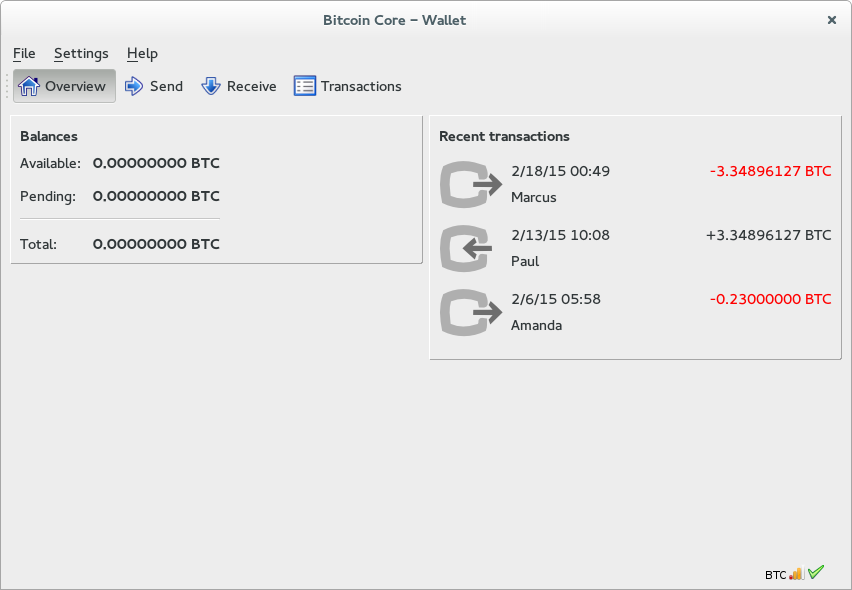
### Smart Contracts and the Explosion of Manual Transactions
Ethereum introduced the idea of adding code into the blockchain directly, allowing smart contracts and decentralized applications (dApps) to run inside the network. But this also introduced a layer of complexity. Each interaction with a smart contract (like staking, lending, or providing liquidity) became a manual transaction.
While smart contracts allowed new use cases for crypto, including DeFi, they were limited in terms of execution. Someone or something must call the smart contract with a transaction. This caused an exponential increase in the number of transactions users needed to handle.
### UX Issues in The Beginning of Web3:
- **Complex Fee Management**: users had to manually set transaction fees, risking delays or overpayments.
- **Address Management**: long, unintuitive addresses led to frequent mistakes.
- **Confirmation Anxiety**: waiting for network confirmations was a new experience.
- **Multiple Steps**: a single DeFi action often requires 3-5 manual confirmations.
- **Gas Fees**: constantly fluctuating, requiring manual adjustments.
- **Wallet Fatigue**: users had to sign dozens of transactions daily, leading to errors and frustration.
## Crosschain Protocols: Another Layer of Complexity
At the current stage of crypto, most protocols enable interactions across multiple blockchains, like Ethereum, Solana, or BNB Chain. While this expands the possibilities, it also increases the number of manual transactions required to interact on this level. The crypto landscape is more fragmented than ever, with new networks appearing constantly.
### Cross-Chain Challenges:
- **Multiple Wallets**: managing assets across different chains.
- **Bridge Risks**: manually bridging tokens introduces both complexity and security risks.
- **Synchronization Issues**: keeping track of assets on various chains requires constant attention.
## Manual Transactions for Users
Performing some basic onchain operations (like swaps or token transfers) manually once or twice seems manageable, but the situation changes when scale comes into play. What happens when you need to execute thousands of transactions, on multiple blockchains?
Suddenly, what was a simple task becomes a burden. A time-consuming and error-prone situation. Crosschain operations require users to manage assets, fees, and risks across different networks, while manually confirming each step. This level of manual interaction is simply unsustainable as the crypto ecosystem grows.
Here is a list of some of the main problems with manual transacting in crypto:
- **Human error:** entering the wrong addresses, miscalculating gas fees, or confirming the wrong transaction are common. There's no "undo" in blockchain.
- **Time-consuming:** each transaction needs careful review, especially when interacting with smart contracts. Time adds up quickly when every action is manual.
- **Non-scalable:** at some point manual transactions don’t scale. A power user handling a lot of transactions daily will encounter a bottleneck to grow.
- **Cost inefficiency:** mistakes, delays, or bad timing can lead to wasted gas fees, lost funds, or missed opportunities in the market.
- **Tedious & repetitive:** clicking “confirm” over and over is not fun. It’s also a poor use of time for users.
- **Security risks:** manual processes increase the chance of falling for phishing, malicious contracts, or simply making costly mistakes.
## Manual Transactions for Developers
There are a lot of developers building their own custom solutions to tackle manual transactions, but sometimes they can become a serious bottleneck:
### Scripting Solutions
To manage repetitive tasks like token transfers or smart contract interactions, many devs resort to writing custom scripts. While these can offer short-term relief, they demand constant maintenance, rigorous testing, and carry the risk of introducing new vulnerabilities.
### Internal Tools
Larger teams might build internal tools or dashboards to streamline transaction handling, but these solutions divert valuable time away from actual innovation and product development. The more time developers spend on manual processes, the less they can focus on improving protocols, deploying new contracts, or enhancing user experience. Worse still, these ad-hoc solutions often rely on private data sources, server-stored keys, and manual intervention—introducing points of failure and security risks.
### Manual Operations in Smart Contract Development
Time spent handling manual processes means less time writing code. Devs often delay pushing updates or deploying contracts due to the overhead of managing transactions manually, such as confirming execution states, or monitoring gas prices manually.
On the other hand, developing smart contracts is complex. The process requires a precise understanding of blockchain behavior, gas optimization, contract security, and integration across different protocols. If you add the need for constant manual intervention, such as crafting custom scripts for recurring tasks, checking for execution triggers, or rebalancing assets across chains, developers face increased mental workload and operational risk.
### Increase of Crosschain Protocols
The rise of crosschain protocols has opened new possibilities for DeFi, but it has also added significant complexity for developers. Integrating multiple networks means dealing with different token standards, bridging mechanisms, and network-specific issues. Each chain has its own tooling, gas fee dynamics, and transaction confirmation processes, requiring developers to work on multiple environments at the same time.
Manual operations across chains amplify this challenge. Developers must monitor and execute transactions on different timelines, ensure asset security during bridges, and handle network-specific errors, all of which increase the risk of mistakes and slow down workflows.
## Onchain Automation is the Future of Crypto Operations
Smart contracts and dealing with onchain assets is a high-stakes environment, where any small error can put funds at risk. Incorrectly calculated slippage, forgotten transaction parameters, or errors in private key management can threaten the security of blockchain projects.
Additionally, these manual workflows often rely on private, centralized data sources and infrastructure (like server-stored keys), introducing single points of failure and undermining the decentralized nature of blockchain systems. Without onchain automation tools, many teams build scripts that are difficult to program and maintain, lacking the flexibility, scalability, and security needed for robust DeFi operations.
As blockchain technology evolves, automation, batch processing, and smart UX layers will be critical. Developers and users alike need tools that reduce friction, eliminate manual bottlenecks, and allow the ecosystem to scale securely and efficiently.
Interested in learning more about onchain automation? Read [our blog here](https://www.mimic.fi/blog/what-is-onchain-automation).
At Mimic, we are building a crosschain automation protocol to simplify the way users build and scale blockchain projects. Mimic Protocol allows developers to define their rules, pick the tasks they want to automate, while the platform handles execution, offering full control over blockchain operations. Mimic enables teams to focus on innovation while the protocol ensures precision, efficiency, and trustless automation.
You can read the Mimic Protocol [whitepaper here](https://www.mimic.fi/documents/Mimic_Protocol_Whitepaper.pdf) (pdf will open up).
# Join the Mimic Protocol Waitlist
As onchain automation continues to transform the way DeFi teams operate, Mimic Protocol is paving the way for a new standard in programmable, decentralized execution.
Beta testing is starting soon. If you're a crypto developer or protocol operator, now’s your chance to get ahead of the curve.
**Get early access to Mimic Protocol by clicking below 👇**

Start simplifying how you code, execute, and scale blockchain projects. **Let automation handle the busy work while you focus on building.**
🐦 [X (Twitter)](https://x.com/mimicfi) | 📚 [Documentation](https://docs.mimic.fi/?utm_source=ghost&utm_medium=blog&utm_campaign=mimic_docs) | 📄 [Whitepaper](https://www.mimic.fi/documents/Mimic_Protocol_Whitepaper.pdf) | 💬 [Discord](https://discord.com/invite/qr2ywWuhxe) | 🌐 [Website](https://www.mimic.fi/) | 🌀 [Farcaster](https://farcaster.xyz/mimicfi) | 💼 [LinkedIn](https://www.linkedin.com/company/mimic-finance)
---
# What is Onchain Automation?
> Onchain automation is the use of smart contracts to automate actions directly on a blockchain when specific conditions are met, reducing the need for manual inputs or offchain actions.
Published: 2025-04-17 | Updated: 2026-02-02 | Author: Mimic Engineering Team | Tags: Onchain Automation | Source: https://www.mimic.fi/blog/what-is-onchain-automation

Welcome to the first blog of a series of educational posts around exciting Web3 topics. At Mimic, we are blockchain infrastructure providers, and we are passionate about moving the crypto industry forward. We believe that there is a heavy reliance on manual processes and transactions in Web3, and we are creating automation tools to simplify the way people code, execute, and scale blockchain projects.
The goal of these blog posts is to share knowledge on key Web3 concepts, such as onchain automation, intents, crosschain, smart contract execution, or chain abstraction. From our years of experience building automation infrastructure for leading DeFi projects, we want to share all our insights around exciting blockchain topics, and start setting the context of Mimic Protocol, our new decentralized automation layer, ahead of its public launch.
### So, what is onchain automation?
Onchain automation is the use of smart contracts and decentralized protocols to automate tasks, actions, or workflows directly on a blockchain when specific conditions are met, eliminating the need for manual inputs or offchain intervention.
In this blog, we will explore how automation is already helping Web2 industries, why it is needed in Web3, and some approaches to solving the current challenges in executing smart contract functions. We will also provide a brief overview of the Mimic Protocol. _Sounds interesting? Let’s dive right in!_
## The Web2 World is Already Automated
Automation has been essential for the growth of many different industries, enabling tasks to be performed with greater efficiency, accuracy, and scalability.
For example, in Web2, the finance, agriculture, energy, software, retail, and logistics sectors have integrated automated systems to improve operations and enhance productivity. In agriculture, automated machinery and irrigation systems have revolutionized farming practices, while automation in logistics, tracking, and transportation systems has massively improved supply chain management.
Automation plays a crucial role in processing transactions, managing accounts, and facilitating different trading activities in finance. The majority of financial transactions are now automated:
- 60-75% of all the trading volume in U.S. equity markets is done through algorithmic trading | [Source](https://www.quantifiedstrategies.com/what-percentage-of-trading-is-algorithmic).
- 98% of all CFOs surveyed by McKinsey are investing in finance automation | [Source](https://www.mckinsey.com/capabilities/strategy-and-corporate-finance/our-insights/toward-the-long-term-cfo-perspectives-on-the-future-of-finance#).
- The network used for electronically moving money between bank accounts across the U.S. processed Over $42 trillion in value in 2024 | [Source](https://www.federalreserve.gov/paymentsystems/fedach_quarterlycomm.htm).
These trends underscore a broader movement towards automation in the financial sector, driven by the need for efficiency, scalability, and enhanced customer experiences.
## Web3 Needs Automation to Grow
Although other industries understand the value of automation, there are still many processes being done manually in Web3. For example, a simple action like sending an ERC20 token from one wallet to another involves:
- Opening and unlocking a wallet.
- Choosing the correct network.
- Clicking on send.
- Entering the recipient address.
- Selecting the asset and amount.
- Setting the transaction fee.
- Double-checking all the details (once a transaction is sent it can’t be reversed).
- Approving the spending.
- Executing the transaction.
At first, handling a few onchain transactions manually doesn’t seem so bad. Still, once the operations multiply (thousands of transactions across multiple chains, triggered by real-time onchain or offchain events), the cracks start to show:
- Time-consuming custom scripts
- Fragile cron jobs and bots
- Increased risk of human error
- High operational overhead
- Poor scalability
Whether building a DeFi protocol, a DAO treasury, or a crosschain app, developers are likely to be involved in many different onchain tasks, such as token swaps, fee distributions, asset bridging, and more, while trying to keep up with shifting market conditions and growing infrastructure demands.
Smart contracts added a new wave of use cases to blockchain networks, but they can’t self-execute any functions. Someone needs to call the contract with a transaction in order for the smart contract to execute any actions.
Given this, if we want to reach the next billion users, we must abandon processes that don’t scale, and it is certain that manual transactions don’t scale well. In traditional tech stacks, we rely on automated pipelines and scheduled tasks. **Why should blockchain be any different?**
Yet, many recurring tasks in blockchain still require human intervention (e.g., manually executing scripts, monitoring market conditions, or toggling smart contracts). This approach limits Web3’s potential because manual effort is prone to error, delay, and unpredictability.
_History shows a few attempts to introduce standardized automation, but none gave developers full flexibility in creating complex workflows._
## Brief History of Blockchain Automation
Smart contracts are often compared to “unstoppable programs” on the blockchain, but one thing they cannot accomplish independently is scheduling future actions. In other words, a contract won’t automatically execute a function at a specific time or when a certain condition is fulfilled. **Someone or something must trigger it with a transaction.**
Initially, this required developers or users to run external scripts (bots) to invoke smart contract functions on a schedule. This approach was inconvenient and created central points of failure.
Thus the demand for reliable onchain automation (crypto cron jobs) was born, and over the years several projects have tackled the challenge with different solutions.
### Ethereum Alarm Clock (2015–2019)
One of the earliest attempts at on-chain automation, Ethereum Alarm Clock, allowed users to schedule transactions for future execution. It enabled users to deposit ETH and specify a time window and call function. However, it never achieved widespread adoption due to costs, complexity, and the lack of incentives for executors ("TimeNodes”).
You can access the [documentation](https://ethereum-alarm-clock.readthedocs.io/en/latest) and [GitHub](https://github.com/ethereum-alarm-clock/ethereum-alarm-clock) pages (which are no longer actively maintained) to learn more about it.
### Keep3r Network (2020)
Launched by Yearn founder Andre Cronje, [Keep3r Network](https://keep3r.network/) introduced a decentralized job board where projects list tasks (like harvesting yield), and independent bots called keepers execute them for KP3R token rewards. The system is fully permissionless—anyone can become a keeper by bonding KP3R—and has been used in protocols like Yearn and Fixed Forex. Its focus is on decentralizing DevOps for DeFi protocols.
### Gelato Network (2020)
[Gelato](https://www.gelato.network/web3-functions) adopted a more developer-friendly approach by offering “automation as a service.” Developers can define tasks (e.g., "run this function every hour" or "when a price hits X") using resolvers or time-based triggers, while Gelato’s decentralized network of bots manages the rest. It minimizes the need to maintain your own infrastructure. The service is utilized across hundreds of DeFi, NFTs, and gaming applications, including projects like Aavegotchi and Beefy Finance.
### OpenZeppelin Defender (2020)
Created by the team behind the most widely used smart contract libraries, [OpenZeppelin Defender](https://www.openzeppelin.com/defender) provided secure, production-ready automation for Ethereum and EVM chains. It includes a suite of tools—Relayers, Autotasks, Sentinels, and Admin—designed for managing smart contracts and automating on-chain operations. Developers can write lightweight scripts (Autotasks) that trigger time-based schedules or smart contract events, executing them through secure relayers. While not fully decentralized, Defender emphasizes security, auditability, and developer experience, making it a favorite among DAOs and protocols like Compound, Optimism, and Gnosis. Recently they have announced that their Relayers and Monitor tools are [now open source](https://blog.openzeppelin.com/monitor-and-relayers-are-now-open-source).
### Chainlink Automation (2021)
Formerly known as Chainlink Keepers, [Chainlink Automation](https://chain.link/automation) brought the reliability of Chainlink’s oracle network to automation.
Developers register an “upkeep” and write a checkUpkeep() function that Chainlink nodes monitor. When the conditions are met, Chainlink performs the task using its decentralized network of trusted nodes. This system is ideal for critical, high-value operations and is utilized by protocols such as Aave, Synthetix, and PoolTogether.
* * *
Each solution demonstrated the growth of Web3’s infrastructure, evolving from basic scheduled calls to comprehensive decentralized automation networks. Collectively, they empower smart contracts to operate independently, eliminating the need for centralized cron jobs.
## Moving Onchain Automation Forward With Mimic Protocol
We are solving the on-chain automation challenge by creating an open, flexible, and programmable [automation layer](https://docs.mimic.fi/).
Since 2021, Mimic has provided automation solutions for major DeFi leaders, including 1inch, Balancer, Ledger, Trezor, Trust Wallet, and WalletConnect. After three years of developing automation for top players in the industry, we are now opening our infrastructure to anyone seeking to elevate their projects to the next level. We aim to assist developers and protocols in scheduling and executing any onchain tasks based on custom conditions, as we recognize that each project requires a unique solution.
Mimic Protocol introduces a new infrastructure that simplifies how you code and scale blockchain projects across different chains. It enables you to [program functions](https://docs.mimic.fi/examples/build-a-simple-function) within your app or directly from your backend and utilize audited and pre-built smart contract functions that can be executed according to the logic you set.
This logic can range from simple triggers, such as dates and times, to complex automation that depends on onchain and offchain events, balance thresholds, and more. As infrastructure providers, the tools we create should be practical and fully customizable.
There are a number of small actions that can be automated, serving as building blocks to scale your applications (like swap, wrap, or bridge). We want to help developers create music: we provide the notes so you can write the songs.
We will delve deeper into how it works in more detail in the near future, but for now, we want to share that the Mimic Protocol consists of [three core layers](https://docs.mimic.fi/developers/architecture): the Planning Layer, the Execution Layer, and the Security Layer. Each layer involves key actors and components collaborating to ensure deterministic task execution, reliable intent handling, and robust security for all user operations.
> **If you are interested in a more technical explanation, here is our** [**whitepaper**](https://www.mimic.fi/documents/Mimic_Protocol_Whitepaper.pdf) **(opens a pdf link).**
## Benefits of Onchain Automation
As DeFi ecosystems become increasingly complex and inherently multichain, onchain automation has emerged as an excellent tool for scaling operations and doing so securely, efficiently, and without human error.
### Key Benefits of Onchain Automation
Onchain automation leverages smart contracts to eliminate the inefficiencies that slow down financial workflows. Here’s what it brings to the table:
- **Efficiency Without Middlemen:** Smart contracts can automatically handle tasks like rebalancing, swaps, or distributions, reducing costs and saving time.
- **24/7 Uptime:** Tasks run continuously, even while you sleep. No human oversight is needed.
- **Trustless Execution:** Code is law; actions follow logic exactly as written, supported by cryptographic proof.
- **Reduced Risk of Human Error:** Deterministic logic eliminates manual steps, ensuring consistent outcomes.
- **Scalability for Complex Operations:** Multi-chain treasury management? DAO workflows? Automation manages it all without requiring additional manpower.
- **Transparency & Auditability:** Every execution is recorded onchain for complete traceability.
### Why Mimic Protocol Sets a New Standard

While the benefits mentioned above apply broadly, Mimic Protocol elevates onchain automation with its modular & decentralized infrastructure, and unmatched customization:
- **Decentralized & Secure Execution:** A global network of relayers, solvers, and oracle verifiers ensures fault tolerance and safe automation without centralized risks.
- **Full Customization:** Each developer can select the components that best suit their needs, with hundreds of configurable parameters, from token lists and gas limits to custom slippage thresholds.
- **Crosschain Power:** Mimic Protocol operates seamlessly across 15+ chains.
- **Onchain & Offchain Simulation:** Optimize gas and swap prices with real-time market simulations prior to every execution.
- **Automation with Intents:** define tasks, which describe what data is needed, how to interpret it, and what conditions must be met to create intents (an intent represents an actionable instruction on the blockchain).
- **User-defined Safeguards:** a settler verifies that everything was done correctly, ensures that user-defined restrictions are respected, and finalizes the transaction outcome.
# Join the Mimic Protocol Waitlist
As onchain automation continues to transform the way DeFi teams operate, Mimic Protocol is paving the way for a new standard in programmable, decentralized execution.
Beta testing is starting soon. If you're a crypto developer or protocol operator, now’s your chance to get ahead of the curve.
### Get early access to Mimic Protocol by clicking below 👇

Start simplifying how you code, execute, and scale blockchain projects. **Let automation handle the busy work while you focus on building.**
🐦 [X (Twitter)](https://x.com/mimicfi) | 📚 [Documentation](https://docs.mimic.fi/) | 📄 [Whitepaper](https://www.mimic.fi/documents/Mimic_Protocol_Whitepaper.pdf) | 💬 [Discord](https://discord.com/invite/qr2ywWuhxe) | 🌐 [Website](https://www.mimic.fi/) | 🌀 [Farcaster](https://farcaster.xyz/mimicfi) | 💼 [LinkedIn](https://www.linkedin.com/company/mimic-finance)
---