
Five years ago, writing smart contracts was rare. But today, Solidity is taught in universities and bootcamps, and AI can write contracts in seconds. The number of people who can write DeFi code has exploded.
But here's the truth: Most DeFi apps don't fail because teams can't write contracts. They fail because of what comes next, the infrastructure deployment and maintenance.
- Bots
- Gas abstraction
- Retry logic
- Monitoring
- Server maintenance
AI can help you write contracts faster, but it does not remove the execution, coordination, and settlement problems. That's where most teams spend months, or give up entirely.
The Real Bottleneck in DeFi Development
In 2026, the real bottleneck in DeFi is not Solidity, it's execution infrastructure.
Let's say you've written the smart contracts needed, compiled and tested them, maybe even audited. It feels like you're on the finish line, but you're not. Writing the smart contracts is just the beginning.
The real work starts when your DeFi apps needs to run reliably in the real world. The moment your app goes live, you now need to handle:
- Transaction monitoring across chains
- Gas price volatility
- Settlement guarantees
- Oracle integrations
- Liquidity and execution routing
- Secure key management for any bots and human operators
- Alerting and monitoring
And none of this is your actual product, it's just what's needed to keep it alive.
The Costs in DeFi Development
- Time cost
Infrastructure maintenance doesn't just add complexity, it adds a lot of time to the development. Time spent writing contracts, bots, scripts. Time spent fixing errors, monitoring dashboards.
- Financial cost
Auditing, running nodes or RPC providers, paying engineers, covering failures, managing gas across chains... all the costs add up.
- Mental energy
This is harder to measure, but instead of managing infrastructure, you could use your mental energy to make your product better.
The Solution: Build the Product, Delegate the Execution
What if building a DeFi app didn't require you to become an infra company? What if you didn't need to manage bots, gas, retries, or servers?
Introducing Mimic
Mimic is a developer platform that allows teams to build blockchain applications without dealing with low-level complexities.
Instead of building and maintaining custom infrastructure, builders can focus on product logic while Mimic handles execution, reliability, and security under the hood.
Developers define what should happen and when, Mimic handles how it happens:
- Write simple, familiar code to define what should happen and when
- Mimic handles execution, data sourcing, coordination, and safeguards
- A decentralized network of three layers powers the platform
- Logic is compiled, executed, and settled with security guarantees
If you want to learn more, check out our documentation at docs.mimic.fi.
Examples of Building With Mimic
We built some real mini-apps on top of Mimic to show how development with our platform could look like.
Each of these examples is simple at the surface: a front-end that connects to Mimic functions. These apps do not rely on custom scripts, RPCs, or cross-chain swaps; all of that is handled and abstracted by the platform.
The app only define the parameters, as a user would interact with any front-end you create to interact with Mimic.
Here are four examples you can explore today:
Swap App
A simple swap interface where users define de source and destination token and chain, amount, and slippage.
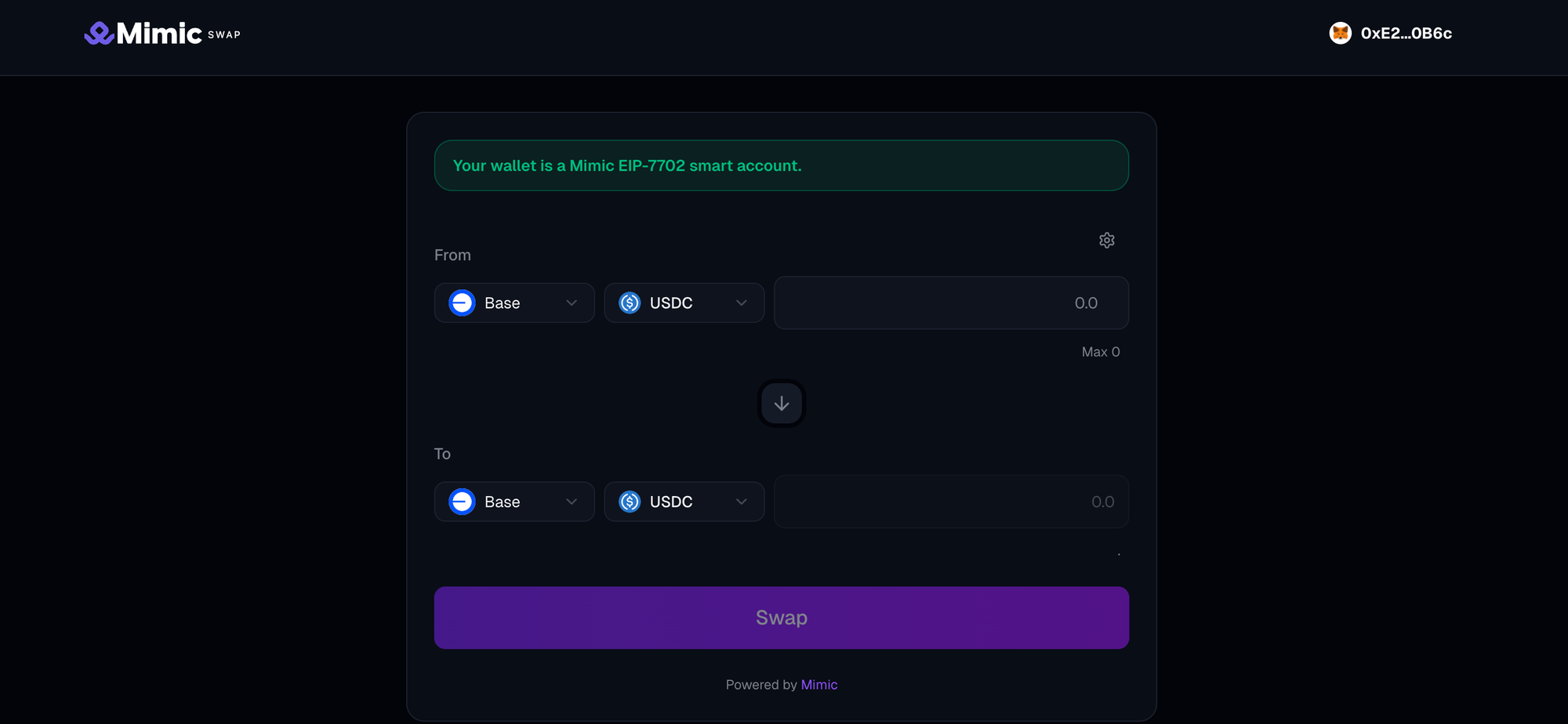
The frontend defines what the user wants, and Mimic handles how it happens.
Link: https://github.com/mimic-fi/ethereum-swap-app-with-mimic
Automated Savings
A recurring savings app that deposits funds into Aave automatically.
Users define the asset, chain, amount, and frequency.
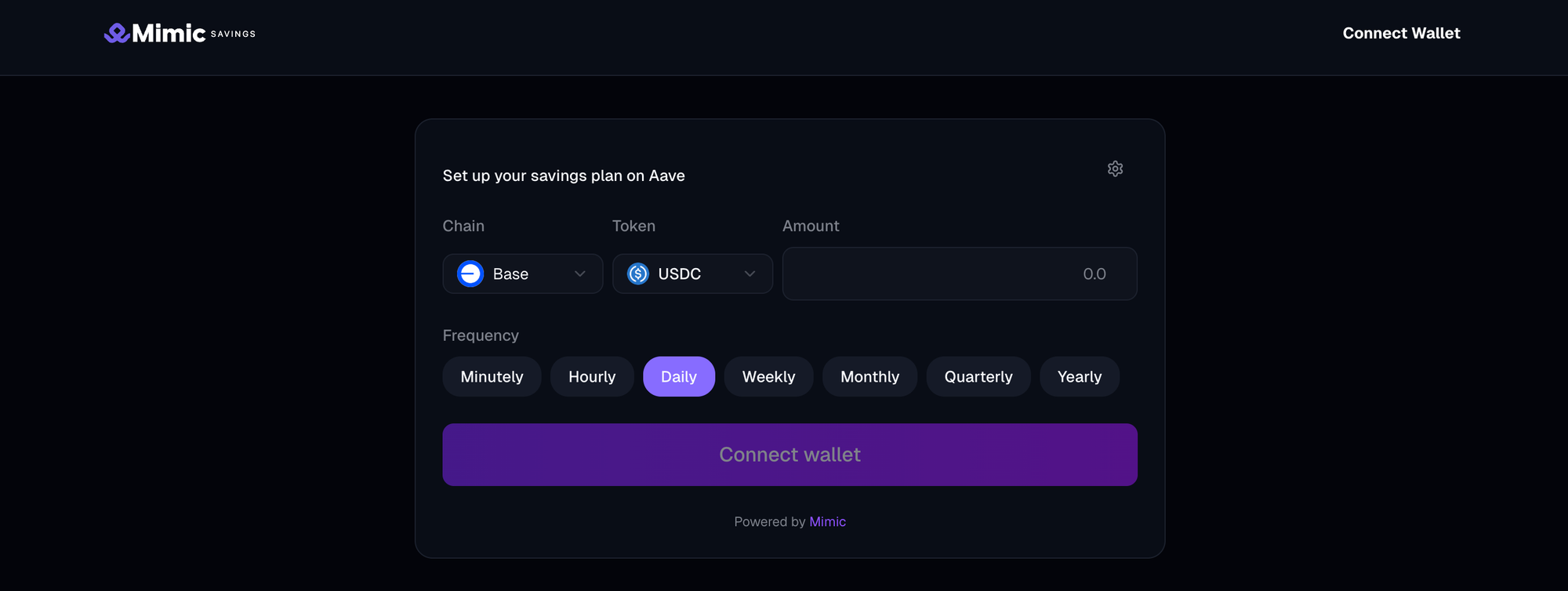
The user can focus on the savings logic, and Mimic ensures it get executed on time.
Link: https://github.com/mimic-fi/aave-savings-app-with-mimic
Cross-Chain Subscriptions
A subscription payment system where users can:
- Pay in any supported token
- On any supported chain
- On a recurring schedule
- Without holding native gas tokens
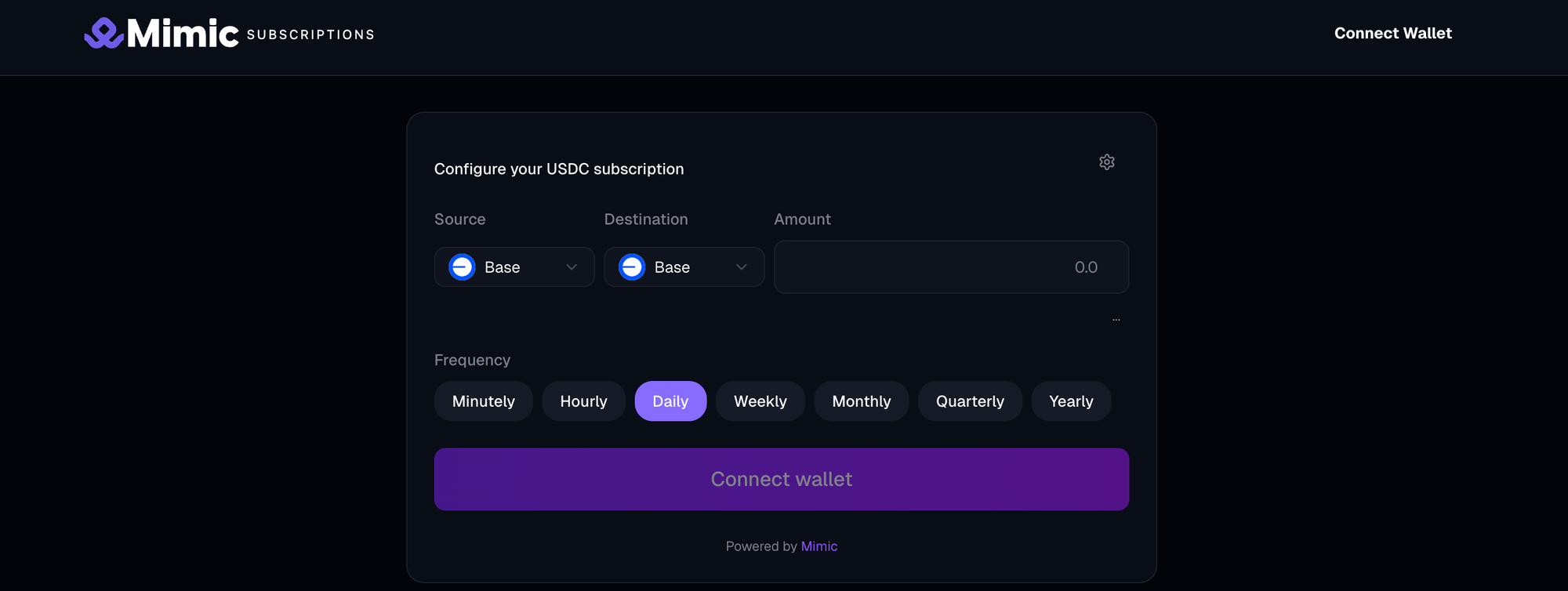
Mimic coordinates execution across chains atomically. From the product side, you’re just defining a recurring payment rule.
Link: https://github.com/mimic-fi/cross-chain-subscription-payments-with-mimic
Card Auto Top-Up
A programmable card top-up system.
Users define the balance threshold, the amount they want to send, the token (and chain) they want to send, and the slippage.
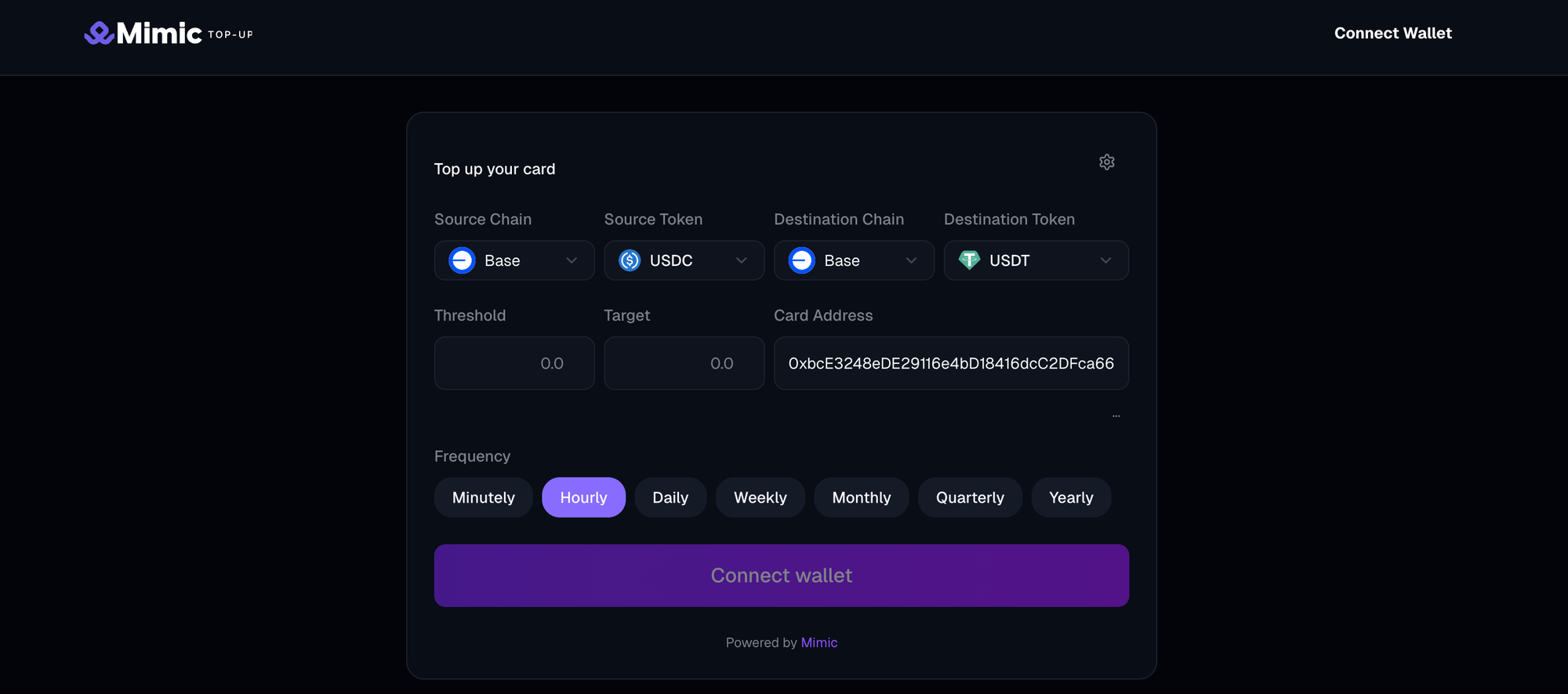
Mimic monitors, routes, swaps, settles, and guarantees the top-up when conditions are met. The product only defines the policy.
Link: https://github.com/mimic-fi/card-top-up-with-mimic
Check the examples here
You can check all these mini-apps and their source code here:
Unlock easier DeFi development with Mimic
Each of these apps would traditionally require:
- Backend infrastructure
- Bots and cron jobs
- Cross-chain bridges
- Gas abstraction layers
- Monitoring dashboards
- Retry systems
- Dedicated DevOps
With Mimic, they require none of that. You define deterministic logic. Mimic compiles it, coordinates it, executes it, and settles it securely.
If you start using Mimic to build DeFi apps, you’ll notice something immediately:
The complexity is gone.
Try Mimic Now!
Available on Arbitrum, Base, Base Sepolia, Ethereum, Gnosis, Optimism, and Sonic.

Start simplifying how you code, execute, and scale blockchain projects. Let Mimic handle the busy work while you focus on building.
🐦 X (Twitter) | 📚 Documentation | 💬 Discord | 💻 Telegram